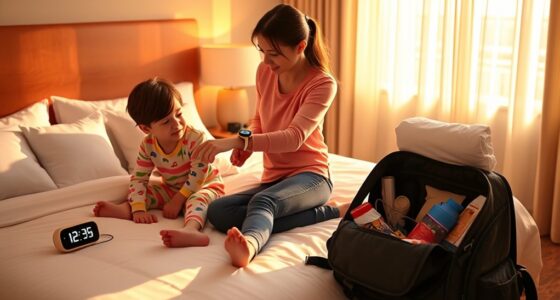
To help your child adjust to a new time zone, establish consistent sleep routines by gradually shifting bedtimes and creating a calming environment with dim lighting and familiar rituals. Support digestion with balanced, familiar meals and proper hydration, and make the space sleep-friendly using blackout curtains or white noise. Incorporate relaxing scents like lavender to ease changeover stress. Continuing with these strategies will provide you with more tips to make the adjustment smoother for your kid.

Get travel and outdoor gear delivered free — and shop member deals
- Fast, free delivery on millions of items
- Access to Prime Big Deal Days deals on October 6–7
- Prime Video, Amazon Music and more included
Key Takeaways
- Gradually adjust your child’s bedtime and wake-up times before travel to ease the transition.
- Maintain familiar bedtime routines and create a calming sleep environment with dim lights and white noise.
- Keep meal times aligned with the new time zone and offer balanced, familiar foods to support digestion.
- Use blackout curtains, white noise, and calming scents like lavender to promote restful sleep in the new environment.
- Prepare in advance and be patient, understanding that consistent routines help children adapt more quickly.

Traveling with kids across time zones can be challenging, especially when jet lag hits. As much as you look forward to your trip, adjusting to a new schedule can leave your children tired, cranky, and out of sync. To help your kids settle in more smoothly, focusing on establishing sleep routines and making dietary adjustments is essential. These steps can markedly ease their transition and reduce the discomfort associated with jet lag.
When it comes to sleep routines, consistency is your best friend. Before your trip, try gradually shifting your child’s bedtime and wake-up time closer to the destination’s schedule. Once you arrive, stick to familiar bedtime rituals, such as reading a story or singing a lullaby, even if the time feels off. Creating a calming environment in the hotel room or accommodation, with dim lighting and minimal noise, helps cue their body that it’s time to wind down. If your child is having trouble sleeping during the adjustment period, consider using white noise machines or blackout curtains to create a cozy, sleep-friendly environment. Keeping the sleep schedule as regular as possible, despite the new time zone, will help reset their internal clock more quickly. Incorporating calming essential oils like lavender or eucalyptus in their sleeping area can also promote relaxation and ease the transition.
Dietary adjustments also play an essential role in combating jet lag. When traveling, your child’s digestion can become unsettled, especially if they’re eating unfamiliar foods or at odd hours. To support their body’s adaptation, aim to maintain a consistent eating schedule aligned with the new time zone. Offer balanced meals rich in fruits, vegetables, lean proteins, and whole grains to provide sustained energy. Avoid heavy, greasy, or sugary foods close to bedtime, as these can interfere with sleep quality. Ensure your child stays well-hydrated, as dehydration can worsen tiredness and discomfort. Bringing familiar snacks from home can help ease dietary transitions and prevent overeating on unfamiliar foods. Also, try to synchronize meal times with local mealtimes, as this helps regulate their biological clock and reinforces the new routine. Additionally, using aromatherapy with calming essential oils like lavender may further support restful sleep and ease their adjustment to the new time zone.
As an affiliate, we earn on qualifying purchases.
Frequently Asked Questions
How Can I Tell if My Child Is Experiencing Jet Lag?
You can tell if your child is experiencing jet lag by observing changes in their sleep patterns and mood. If they’re having trouble falling asleep or waking up at unusual hours, it’s a sign. Also, watch for mood changes like irritability or fatigue. These symptoms often happen when their internal clock is out of sync with the new time zone. With patience, their sleep and mood should gradually improve.
What Are Signs of Severe Jet Lag in Children?
Severe jet lag in children can be like a storm cloud over their usual routine. Watch for persistent sleep disruptions, where they struggle to fall asleep or wake up frequently. Mood changes, such as increased irritability, sadness, or anxiety, can also signal it’s more than just adjusting. If these signs last several days and interfere with their daily activities, it’s time to consult a healthcare professional for guidance.
Are There Specific Foods That Help Children Adjust Faster?
You can help your child adjust faster by offering healthy snacks like fruits, nuts, and whole grains that provide lasting energy. Incorporate hydration strategies, such as encouraging water and electrolyte drinks, to prevent dehydration and promote better sleep. Avoid sugary or processed foods, as they can disrupt their sleep cycle. Keeping a balanced diet and ensuring proper hydration support their body’s natural adaptation to new time zones.
When Should I Seek Medical Advice for My Child’s Jet Lag?
Did you know that around 10-15% of children experience severe sleep disruption from jet lag? You should seek medical advice if your child’s sleep issues persist beyond a few days, or if they show signs of extreme fatigue, irritability, or behavioral changes. Consult a healthcare professional before considering medication options. Prompt medical attention guarantees safe management and helps your child adjust more comfortably to new time zones.
How Can I Prevent Jet Lag in Very Young Children?
To prevent jet lag in very young children, establish consistent sleep routines before the trip. Bright light exposure during the day helps reset their internal clock, so encourage outdoor activities during daylight hours. Avoid bright screens and stimulating activities close to bedtime, and keep sleep environments quiet and dark. These strategies help children adapt more quickly, ensuring they rest well despite crossing time zones.
blackout curtains for children’s bedrooms
As an affiliate, we earn on qualifying purchases.
As an affiliate, we earn on qualifying purchases.
Conclusion
Adjusting to a new time zone is like riding a wave—you’ll have moments of turbulence, but with patience and preparation, you’ll find your balance again. Remember, every small step you take helps your child settle in smoother and faster. Trust in your routines and stay flexible. Just like a surfer learning to ride each wave, you’ll master this shift together, turning what feels like chaos into calm, and helping your child thrive in their new environment.
As an affiliate, we earn on qualifying purchases.
As an affiliate, we earn on qualifying purchases.
Fall Picks
fall essentials
As an affiliate, we earn on qualifying purchases.