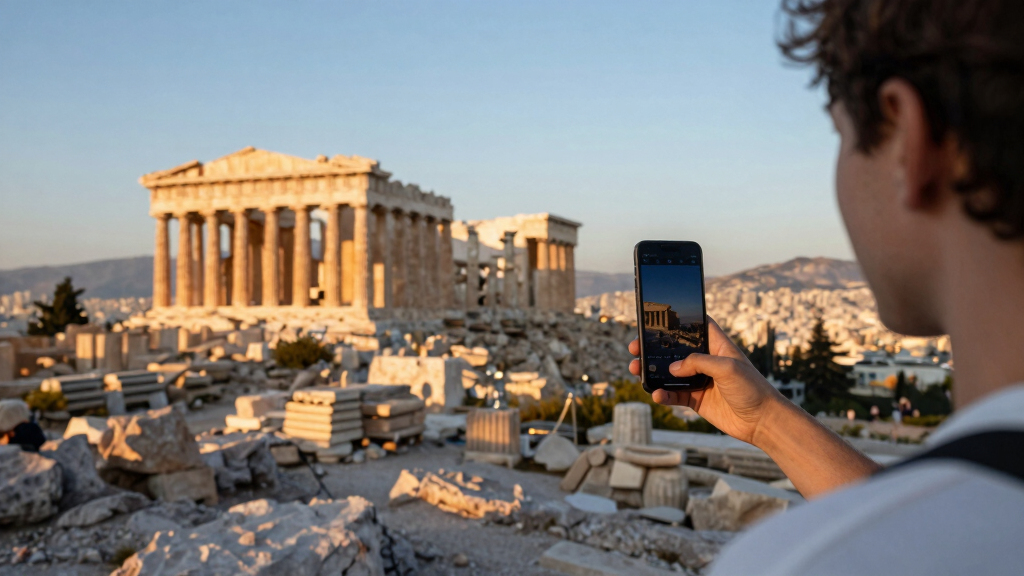

TL;DR
Researchers and digital artists have created detailed 3D reconstructions of Athens’ Acropolis, illustrating its original appearance. This development aims to improve public understanding of ancient Greek architecture and history. The project combines current ruins with virtual models, offering new insights into the site’s original grandeur.
A new project has produced detailed 3D reconstructions of Athens’ Acropolis, offering a clearer view of how the site appeared during Greece’s golden age. The initiative aims to enhance public understanding of ancient Greek architecture and history by combining current ruins with virtual models.
The project, led by digital artist Manuel Bravo, integrates advanced 3D modeling technology to recreate the original appearance of key structures such as the Parthenon and the Temple of Athena Nike. These reconstructions are based on extensive archaeological research and historical data, allowing viewers to visualize the Acropolis as it once stood. Bravo emphasizes that the approach reflects the intended experience of ancient Greek architects, including the dramatic ascent up the hill and the strategic placement of buildings to evoke awe. The reconstructions are accessible online, providing an immersive experience for both tourists and scholars. Currently, the Parthenon is visible without scaffolding for the first time in 200 years, but the full fidelity of the original structure, including its sculptures and interior details, is best appreciated through these digital models.
Why It Matters
This development matters because it enhances educational and cultural engagement with one of the world’s most iconic archaeological sites. It allows a broader audience to appreciate the scale and grandeur of ancient Greek architecture, which is often obscured by ruins and scaffolding. For scholars, the models provide a new tool for analysis and interpretation, potentially influencing future restorations and preservation efforts. For visitors, the reconstructions deepen understanding and foster appreciation of Greece’s historical legacy, promoting cultural tourism and heritage conservation.

Estia Creations Acropolis of Athens Greece Monument – Parthenon – Herodes Atticus – Dionysus Theatre
- Location: Acropolis of Athens, Greece
- Historical Significance: Contains ancient architectural remains
- Main Structure: Parthenon replica
As an affiliate, we earn on qualifying purchases.
As an affiliate, we earn on qualifying purchases.
Background
The Acropolis has been a symbol of ancient Greece and Western civilization for centuries, originally built as a Mycenaean fortress in the 13th century BC. Over the centuries, it served various religious and military functions before becoming a ruin. Recent efforts to restore or preserve the site have been limited, with scaffolding obscuring the Parthenon for nearly 200 years. Digital reconstruction projects have gained popularity as a way to visualize the site’s original splendor, with previous models offering partial views. This new project advances those efforts by providing more accurate, detailed, and immersive visualizations based on the latest archaeological findings.
“Our goal was to create a visualization that truly captures the intended experience of the ancient architects, from the ascent to the sacred space to the dramatic views from within.”
— Manuel Bravo

Ancient Greece: Art, Architecture, and History
- Condition: Used Book in Good Condition
As an affiliate, we earn on qualifying purchases.
As an affiliate, we earn on qualifying purchases.
What Remains Unclear
While the reconstructions are based on the best available data, some details—such as interior designs and sculptures—remain speculative. It is also unclear how future archaeological discoveries might alter current models or interpretations. The digital reconstructions are not official restorations but visualizations that aim to approximate the original appearance.

Heromask Educational VR Headset for Kids 5-12, Math Games, Phone Powered
- Uses Your Existing Phone: Requires a compatible smartphone (not included)
- Engaging Math Games: Improves mental math and problem-solving skills
- Teacher-Designed Brain Training: Builds fluency, speed, and confidence in math
As an affiliate, we earn on qualifying purchases.
As an affiliate, we earn on qualifying purchases.
What’s Next
Next steps include expanding the models to include interior spaces and sculptures, integrating virtual reality experiences, and collaborating with museums and educational institutions. Further archaeological research may refine the reconstructions, and efforts are underway to make these models accessible to a global audience through online platforms and exhibitions.

Lllunimon Acropolis Parthenon Statue World Famous Architecture Model, Resin Crafts Ornaments Crafts Souvenir Decor Gifts
- Iconic Greek Temple: Parthenon replica for decoration
- Dimensions: 23x14x8.5cm (9.05×5.51×3.34 inches)
- High-Quality Material: Made of durable resin, hand-painted
As an affiliate, we earn on qualifying purchases.
As an affiliate, we earn on qualifying purchases.
Key Questions
How accurate are these 3D reconstructions?
The reconstructions are based on the latest archaeological research and historical data, but some details remain speculative due to gaps in the evidence. They aim to be as accurate as current knowledge allows.
Can I see the reconstructions online?
Yes, the models are accessible through dedicated websites and virtual tour platforms, allowing users worldwide to explore the Acropolis in its original form.
Will these models replace physical restoration efforts?
No, they are visualizations meant to enhance understanding and educational engagement. Actual restoration and preservation are guided by archaeological and conservation standards.
Are there plans to include interior details in the models?
Yes, future phases aim to incorporate interior reconstructions, sculptures, and other architectural features as new discoveries and research become available.
Source: The best free cultural & educational media on the web – Open Culture