
For a strong all-around choice, I’d start with the EPICKA Universal Travel Adapter, which pairs one AC outlet with three USB-C and two USB-A ports for travelers carrying several devices. The Anker Nano 5-in-1 is a more compact option for lighter charging needs, while the MOMAX 70W GaN Universal Travel Adapter suits trips where higher-powered USB-C charging matters. The main tradeoffs are size, charging power, port count, and whether you need broad plug coverage or a simple adapter for one region. A travel adapter changes plug shape; it may not convert voltage, so appliance compatibility matters too. Read on for the full breakdown and guidance on choosing among these portable travel adapters.

Get travel and outdoor gear delivered free with Prime
- Fast, free delivery on millions of items
- Prime Video, Amazon Music and more included
- Member-only deals all year
Complete the kit



Key Takeaways
- The EPICKA stands out for shared charging: Its mix of one AC outlet, three USB-C ports, and two USB-A ports gives travelers more connection options than the smaller Anker Nano.
- Higher USB-C wattage is a different kind of advantage: The 70W MOMAX and Baseus models target power-hungry devices, while the 20W Anker Nano prioritizes a smaller, simpler carry.
- Universal adapters and regional adapters solve different problems: TESSAN’s two-pack Type C adapters are suited to European trips, while universal models are more flexible across destinations.
- Port count alone does not tell the whole story: Buyers should check whether listed charging power is shared across connected devices and whether the AC outlet can be used at the same time.
- Some picks are trip-specific rather than all-purpose: The Ceptics kit adds two USA sockets and a cable, while the Baseus model’s retractable USB-C cable may reduce loose-cable clutter.
| EPICKA Universal Travel Adapter with 1 AC, 3 USB-C, and 2 USB-A Ports |  | Best Overall for Multi-Device Trips | Plug types: EU, US, UK, and AUS | Country coverage: More than 200 countries and regions; excludes South Africa and India | Ports: 1 AC socket, 3 USB-C, 2 USB-A | VIEW LATEST PRICE | See Our Full Breakdown |
| Anker Nano 5-in-1 Travel Adapter with 20W USB-C Charging |  | Best Compact Pick | Supported plug types: Type A, Type C, Type G, Type I | Ports and outlets: 1 AC outlet, 2 USB-A, 2 USB-C | USB output: Up to 20W total; up to 20W from one USB-C port; 15W maximum when shared | VIEW LATEST PRICE | See Our Full Breakdown |
| Ceptics 45W Universal Travel Adapter with 3 USB-A and 2 USB-C Ports |  | Best for Faster USB-C Charging | Model: UP-11KU | Plug types: A, C, G, I | Ports: 3 USB-A, 2 USB-C, 1 universal socket | VIEW LATEST PRICE | See Our Full Breakdown |
| TESSAN European Travel Plug Adapter 2 Pack, Type C Plug |  | Best for European Stays with Multiple Outlets | Number of items: 2 | Plug type: Type C | AC outlets: 4 per adapter | VIEW LATEST PRICE | See Our Full Breakdown |
| TESSAN Universal Travel Adapter with 3 USB-C and 2 USB-A Ports, 28W |  | Best Value for Several USB Devices | Plug types: Type C, G, A, I | Country coverage: More than 150 countries | Ports: 1 AC outlet, 3 USB-C, 2 USB-A | VIEW LATEST PRICE | See Our Full Breakdown |
| NEWVANGA Universal Travel Adapter with USB-C PD 3.0 and USB-A |  | Best Lightweight Pick | Input: 100–240V, 50/60Hz | USB-C output: 20W / 3A, PD 3.0 | USB ports: 1 USB-C, 1 USB-A | VIEW LATEST PRICE | See Our Full Breakdown |
| MOMAX 70W GaN Universal Travel Adapter |  | Best for Laptop Charging | Model: UA8A | USB-C ports: 3 | USB-A ports: 2 | VIEW LATEST PRICE | See Our Full Breakdown |
| decqle Universal Travel Adapter with 2 USB-C and 1 USB-A Port | 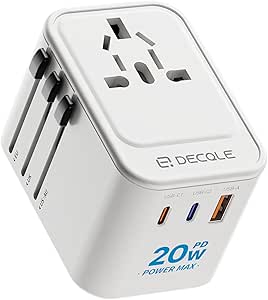 | Best Compact Three-Port Option | Plug types: Type C, G, A, I | Country coverage: 224+ countries; excludes Type D, Type M, and South Korea | USB ports: 2 USB-C, 1 USB-A | VIEW LATEST PRICE | See Our Full Breakdown |
| Ceptics 35W Universal Travel Adapter Kit with 2 USA Sockets, USB-A, USB-C PD 35W, and Cable | 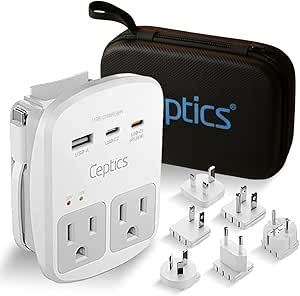 | Best for Plug-Type Flexibility | Model: WPS-2B+ | Input voltage: 100–240V | USB-C Power Delivery: 35W | VIEW LATEST PRICE | See Our Full Breakdown |
| UGREEN 45W GaN 6-Port Universal Travel Adapter |  | Best for Shared Charging | Model: S534 | Maximum charging power: 45W | Ports and outlets: 2 USB-C, 2 USB-A, 2 AC outlets | VIEW LATEST PRICE | See Our Full Breakdown |
| Bates Universal Travel Adapter for USA, EU, UK, Australia, and India |  | Best Compact Plug Adapter | Brand: Bates | Model: TJEK001B448KB | Weight: 3.2 oz | VIEW LATEST PRICE | See Our Full Breakdown |
| Anker Nano 5-in-1 Travel Adapter, 20W |  | Best for Everyday Multi-Device Charging | Brand: Anker | Model: A9215 | Ports and outlets: 1 AC outlet, 2 USB-A ports, 2 USB-C ports | VIEW LATEST PRICE | See Our Full Breakdown |
| Baseus Enercore CG11 70W Universal Travel Adapter with Retractable USB-C Cable |  | Best for High-Power USB-C Charging | Brand: Baseus | Model: Enercore CG11 (E0307E) | Maximum USB-C output: 70W | VIEW LATEST PRICE | See Our Full Breakdown |
| portable travel adapter | Plug types | Model |
|---|---|---|
| EPICKA Universal Travel Adapte | EU, US, UK, and AUS | — |
| Anker Nano 5-in-1 Travel Adapt | — | — |
| Ceptics 45W Universal Travel A | A, C, G, I | UP-11KU |
| TESSAN European Travel Plug Ad | — | — |
| TESSAN Universal Travel Adapte | Type C, G, A, I | — |
| NEWVANGA Universal Travel Adap | US, EU, UK, AU | — |
| MOMAX 70W GaN Universal Travel | C, G, I, A | UA8A |
| decqle Universal Travel Adapte | Type C, G, A, I | — |
| Ceptics 35W Universal Travel A | — | WPS-2B+ |
| UGREEN 45W GaN 6-Port Universa | — | S534 |
| Bates Universal Travel Adapter | — | TJEK001B448KB |
| Anker Nano 5-in-1 Travel Adapt | Type A, Type C, Type G, Type I | A9215 |
| Baseus Enercore CG11 70W Unive | C, A, G, I | Enercore CG11 (E0307E) |
More Details on Our Top Picks
EPICKA Universal Travel Adapter with 1 AC, 3 USB-C, and 2 USB-A Ports
For travelers who want one adapter to cover a broad itinerary and several gadgets, the EPICKA TA-105+ offers a useful balance of plug coverage and charging capacity. Its four plug types work across more than 200 countries and regions, while five USB ports plus an AC socket let it serve up to six devices at once. Compared with the Anker Nano 5-in-1, EPICKA adds a USB port and accepts a wider range of plug types, but it is less compact and its USB-C output is listed at 3A rather than a specified 20W single-port output. A replaceable fuse, spare fuse, safety shutters, and plug lock add practical safeguards. The tradeoff is that it does not convert voltage, and it excludes South Africa and India; high-power appliances such as hair dryers are poor matches.
Pros:- Four plug types cover more than 200 countries and regions, with South Africa and India excluded.
- Five USB ports and one AC socket support charging up to six devices at once.
- Replaceable 10A fuse and one spare are included.
- Safety shutters and a plug lock add protection against accidental contact or loose plug selection.
Cons:- Does not convert voltage, so connected devices must support the local supply.
- Not suited to high-power appliances such as hair dryers and curling irons.
- Excludes South Africa and India despite its broad stated coverage.
Best for: International travelers carrying several phones, tablets, or other dual-voltage devices who want broad plug coverage and a replaceable fuse.
Not ideal for: Travelers bound for South Africa or India, or anyone who needs voltage conversion or an adapter for a high-power hair dryer or curling iron.
- Plug types:EU, US, UK, and AUS
- Country coverage:More than 200 countries and regions; excludes South Africa and India
- Ports:1 AC socket, 3 USB-C, 2 USB-A
- USB-C output:3A
- USB-A output:2.4A
- Maximum power:1100W at 110V; 2400W at 240V
- Fuse:Replaceable 10A fuse; 1 spare included
- Safety features:Safety shutters and plug lock
Our verdict“Choose the EPICKA for multi-device international trips where broad plug coverage matters more than a compact body or voltage conversion.”
Anker Nano 5-in-1 Travel Adapter with 20W USB-C Charging
The Anker Nano 5-in-1 suits travelers who want a small adapter for a few everyday devices rather than a high-capacity charging hub. At 3.77 ounces, with foldable, retractable pins, it packs more neatly than the EPICKA TA-105+ and still supports Type A, C, G, and I plugs. One USB-C port can deliver up to 20W when used alone, a useful advantage for charging a compatible phone, though the total USB output falls to 15W when ports are shared. Its AC outlet also does not accept grounded three-prong plugs, a limitation the EPICKA does not specify. The adapter does not convert voltage, so check device compatibility before plugging in. This is a portability-first choice, not the strongest option for several power-hungry USB devices.
Pros:- Compact 3.77-ounce body with foldable, retractable pins.
- Supports Type A, C, G, and I plug types.
- Single USB-C port provides up to 20W when used alone.
- Charges up to five devices through its AC outlet and four USB ports.
Cons:- USB output is limited to 15W when shared across ports.
- AC outlet does not accept grounded three-prong plugs.
- Does not convert voltage.
Best for: Light packers carrying a phone and a few small devices who value retractable pins and a compact adapter for Type A, C, G, or I destinations.
Not ideal for: Travelers with grounded three-prong AC plugs or several devices that need higher shared USB charging output.
- Supported plug types:Type A, Type C, Type G, Type I
- Ports and outlets:1 AC outlet, 2 USB-A, 2 USB-C
- USB output:Up to 20W total; up to 20W from one USB-C port; 15W maximum when shared
- Maximum current:6A
- Dimensions:3.39 × 1.97 × 0.98 in
- Weight:3.77 oz
- Voltage conversion:Not supported
- Grounded plugs:AC outlet does not support grounded three-prong plugs
Our verdict“Pick the Anker Nano when low packing bulk and a 20W solo USB-C port matter more than broad charging capacity.”
Ceptics 45W Universal Travel Adapter with 3 USB-A and 2 USB-C Ports
The Ceptics UP-11KU is a stronger fit for travelers who want faster USB charging without giving up a universal AC socket. Its 45W maximum output, USB-C Power Delivery, and Quick Charge 3.0 give compatible devices more charging headroom than the EPICKA TA-105+, whose USB-C output is specified at 3A without a wattage figure. Ceptics also provides three USB-A ports, two USB-C ports, and support for Type A, C, G, and I plugs. At 5.9 ounces, it is not as light as the Anker Nano, but it offers more USB ports and higher stated output. A fuse, spare fuse, safety shutters, and plug lock round out the practical feature set. The main limit remains familiar: it does not convert voltage, so single-voltage appliances are unsuitable.
Pros:- Up to 45W charging with USB-C Power Delivery and Quick Charge 3.0.
- Three USB-A ports, two USB-C ports, and a universal AC socket.
- Supports Type A, C, G, and I plugs.
- Includes an 8A fuse, an extra fuse, safety shutters, and a plug lock.
Cons:- Does not convert voltage; connected devices must support 100–240V.
- Not compatible with 110V-only appliances such as hair dryers and curling irons.
- At 5.9 ounces, it weighs more than the Anker Nano.
Best for: Travelers carrying multiple phones or tablets, including devices compatible with USB-C Power Delivery or Quick Charge 3.0, who also need a universal AC socket.
Not ideal for: Anyone bringing 110V-only appliances such as a hair dryer, or travelers who prioritize the lightest adapter over charging output.
- Model:UP-11KU
- Plug types:A, C, G, I
- Ports:3 USB-A, 2 USB-C, 1 universal socket
- Maximum charging output:45W
- USB-C features:Power Delivery and Quick Charge 3.0 on one USB-C port
- Fuse:8A; extra included
- Dimensions:2 × 1.8 × 3 in
- Weight:5.9 oz
Our verdict“Choose Ceptics if compatible devices can benefit from its higher stated USB output and you can accept a heavier adapter with no voltage conversion.”
TESSAN European Travel Plug Adapter 2 Pack, Type C Plug
For a Europe-focused trip, the TESSAN TS-161-EU-C-PD two-pack trades universal coverage for more ways to connect devices at each stop. Each adapter has four Type C AC outlets, two USB-A ports, and a 15W USB-C port, so it can serve a room with several chargers more neatly than the single-AC-outlet EPICKA or Ceptics adapters. Having two units can also help travelers split charging between hotel rooms or bags. That convenience comes with a firm geographic limit: its Type C plug is not suitable for UK or Ireland outlets, unlike the Anker Nano, which supports Type G. It supports a 100–250V range but does not convert voltage, and there is no built-in surge protection. This is a destination-specific splitter, not an all-purpose international adapter.
Pros:- Two adapters are included, useful for sharing or charging in separate locations.
- Each unit provides four AC outlets, two USB-A ports, and one USB-C port.
- USB-C delivers up to 15W.
- Supports a 100–250V input range.
Cons:- Type C plug is not suitable for UK or Ireland outlets.
- Does not convert voltage, so devices must support the local supply.
- No built-in surge protection.
Best for: Couples or families staying in Type C outlet regions who want two adapters with several AC sockets and USB charging at each.
Not ideal for: Travelers with UK or Ireland stops, or anyone seeking one adapter for a multi-region itinerary or built-in surge protection.
- Number of items:2
- Plug type:Type C
- AC outlets:4 per adapter
- USB ports:2 USB-A and 1 USB-C per adapter
- USB-C output:15W (3A)
- Input voltage range:100–250V
- Maximum power:2500W at 250V; 1000W at 100V
- Dimensions and weight:3.15 × 2.24 × 2.63 in; 3.48 oz
Our verdict“Choose this two-pack for stays with Type C outlets where multiple AC sockets matter more than universal destination coverage.”
TESSAN Universal Travel Adapter with 3 USB-C and 2 USB-A Ports, 28W
The TESSAN TS-WTA08 is a practical middle ground for travelers who want five USB ports and broad plug support without moving to a more specialized fast-charging adapter. Its Type C, G, A, and I plugs cover more than 150 countries, and the 28W total USB output can serve up to six devices alongside the AC outlet. Compared with the EPICKA, it offers a stated 28W USB ceiling and dual 10A fuses, while EPICKA lists wider country coverage and includes safety shutters and a plug lock. Unlike Ceptics, TESSAN does not list Power Delivery or Quick Charge support, so travelers seeking those charging standards should look elsewhere. It also lacks surge protection and does not convert voltage; the compact format cannot make an incompatible appliance safe to use.
Pros:- Four plug types support use in more than 150 countries.
- Three USB-C ports, two USB-A ports, and an AC outlet can charge up to six devices.
- USB output is rated at up to 28W total.
- Dual 10A fuses provide fuse protection.
Cons:- Does not convert voltage, so appliances must support the local supply.
- No surge protection.
- No power cord, which may limit placement when outlets are awkwardly positioned.
Best for: Travelers with several phones, earbuds, or other USB devices who need Type C, G, A, or I plug support and prefer a compact multi-port adapter.
Not ideal for: Users who need voltage conversion, surge protection, or clearly specified USB-C Power Delivery for faster charging of compatible devices.
- Plug types:Type C, G, A, I
- Country coverage:More than 150 countries
- Ports:1 AC outlet, 3 USB-C, 2 USB-A
- Maximum USB output:5.6A / 28W
- USB-C output:Up to 15W per port
- USB-A output:Up to 12W
- AC outlet maximum:2500W
- Fuse protection:Dual 10A fuses
- Dimensions and weight:2.53 × 2.15 × 1.97 in; 5.31 oz
Our verdict“Pick the TESSAN TS-WTA08 for compact multi-device charging across several plug regions, but not for voltage conversion or surge protection.”
NEWVANGA Universal Travel Adapter with USB-C PD 3.0 and USB-A
At 3.2 ounces, the NEWVANGA is a sensible choice when keeping luggage light matters more than charging a full set of devices at once. Its plug types cover the US, EU, UK, and Australia, while the 20W USB-C PD port can speed up charging for compatible phones and tablets. Compared with the Ceptics 35W kit, it is lighter and simpler to pack, but it gives up the Ceptics’ extra interchangeable plugs, second US outlet, and higher USB-C output. You get just one USB-C and one USB-A port, so this is better for a solo traveler than a family sharing outlets. Built-in shutters and dual fuses add protection, but they do not make it a voltage converter: appliances must support the destination’s voltage.
Pros:- Lightweight 3.2-ounce design is easy to pack.
- USB-C PD output reaches 20W for compatible devices.
- Supports US, EU, UK, and Australian plug types.
- Safety shutters and dual 8A fuses provide built-in electrical safeguards.
Cons:- Only one USB-C and one USB-A port for charging.
- Does not convert voltage, so connected appliances must support local voltage.
- Charging speed depends on device compatibility with its charging protocols.
Best for: Solo travelers who want a lightweight adapter for a phone and one additional USB device across common international plug types.
Not ideal for: Travelers charging several devices or using appliances that require voltage conversion; this adapter has only two USB ports and does not convert voltage.
- Input:100–240V, 50/60Hz
- USB-C output:20W / 3A, PD 3.0
- USB ports:1 USB-C, 1 USB-A
- Plug types:US, EU, UK, AU
- Maximum power:880W at 110V; 1920W at 240V
- Weight:3.2 oz
- Dimensions:3.0 × 1.9 × 1.5 in
- Safety features:Dual 8A fuses, safety shutters, over-current/voltage protection
Our verdict“Choose the NEWVANGA if a light, straightforward adapter for a phone and one other device matters more than high-wattage or multi-device charging.”
MOMAX 70W GaN Universal Travel Adapter
The MOMAX stands apart in this group for travelers who want to power a laptop and several smaller devices from one adapter. Its 70W USB-C output and five USB ports offer more charging capacity than the NEWVANGA’s two-port setup, while the separate universal AC outlet handles another plug-in device. That makes it a stronger shared charging hub, though its AC outlet has a stated load limit and should not be treated as a high-power appliance solution. Four plug types cover more than 224 countries and regions, but destination compatibility still deserves a check before departure. The meaningful compromise is safety scope: MOMAX lists overload and short-circuit protection, but no surge protection and no voltage conversion. It suits electronics users, not travelers expecting an all-purpose converter.
Pros:- USB-C1 delivers up to 70W for compatible laptops and other devices.
- Three USB-C and two USB-A ports support several devices at once.
- Four plug types cover more than 224 countries and regions.
- Dual fuse protection addresses overload and short circuits.
Cons:- No voltage conversion, so devices must support local voltage.
- No surge protection is specified.
- AC load is limited to 1100W at 110V or 2500W at 250V.
Best for: Laptop-carrying travelers or couples who need high-output USB-C charging and multiple USB ports from a single international adapter.
Not ideal for: People using appliances that need voltage conversion or travelers who specifically want surge protection; neither is provided.
- Model:UA8A
- USB-C ports:3
- USB-A ports:2
- Maximum USB-C output:70W
- Charging protocols:PD 3.0/2.0, PPS, QC 3.0
- Plug types:C, G, I, A
- Maximum AC load:1100W at 110V; 2500W at 250V
- Protection:10A dual fuse for overload and short circuit; no surge protection
- Voltage conversion:None
Our verdict“Pick the MOMAX when laptop-level USB-C power and several charging ports matter more than surge protection or voltage conversion.”
decqle Universal Travel Adapter with 2 USB-C and 1 USB-A Port
The decqle’s appeal is its compact, retractable-pin design paired with two USB-C ports and one USB-A port. It gives travelers more USB-C flexibility than the NEWVANGA, which has just one USB-C port, but its total USB output tops out at 20W, so it is not the pick for fast-charging several devices or powering a demanding laptop. Four plug types cover many destinations, yet the stated exclusions—including Type D, Type M, and South Korea—make destination checks especially important. Its PC case, two 8A fuses, and included spare fuse add practical safeguards for a small travel unit. Like the UGREEN 45W, it does not convert voltage; unlike that model, it prioritizes compactness and USB-C count over higher charging output and two AC outlets.
Pros:- Two USB-C ports plus one USB-A port provide flexible device charging.
- Retractable pins and compact dimensions help with packing.
- Four plug types cover many international destinations.
- Includes two 8A fuses and one replacement fuse.
Cons:- USB output is limited to 20W, restricting charging speed and laptop use.
- Does not convert voltage.
- Not compatible with Type D or Type M plugs or South Korea.
Best for: Travelers who want a compact adapter with two USB-C ports for phones and small electronics, and who have checked their destination’s plug type.
Not ideal for: Laptop users needing more than 20W USB charging, or travelers headed to locations using Type D or Type M plugs or South Korean outlets.
- Plug types:Type C, G, A, I
- Country coverage:224+ countries; excludes Type D, Type M, and South Korea
- USB ports:2 USB-C, 1 USB-A
- Maximum USB output:20W PD
- Maximum AC power:2000W
- Input voltage:100–250V
- Size and weight:7.6 × 5.3 × 5.9 cm; 148g
- Fuses:Two 8A fuses, one replacement
- Voltage conversion:Not supported
Our verdict“Choose the decqle for compact three-port USB charging if its destination coverage and 20W ceiling fit your devices.”
Ceptics 35W Universal Travel Adapter Kit with 2 USA Sockets, USB-A, USB-C PD 35W, and Cable
The Ceptics kit is the most adaptable choice here for travelers whose itineraries span several outlet standards: it includes six interchangeable plugs, including options for Europe, the UK, China, Australia, and Japan, plus two US outlets. Its 35W USB-C PD port gives it more headroom than the NEWVANGA’s 20W port for compatible tablets and some laptops, and the included cable helps keep small accessories together. The tradeoff is a kit-based design rather than the MOMAX’s built-in five-port charging hub; Ceptics offers only one USB-A and one USB-C port, so it is less suited to a group charging many devices. Surge protection and a voltage indicator are useful additions, but this is not a voltage converter, and some regional adapters, such as South Africa’s, are sold separately.
Pros:- Six interchangeable plugs cover several major travel regions.
- Two US outlets allow two plug-in devices at once.
- 35W USB-C PD supports faster charging for compatible devices.
- Built-in surge protection and voltage indicator add useful safeguards.
Cons:- Only one USB-A and one USB-C port, fewer than the MOMAX’s five USB ports.
- Does not convert voltage for incompatible appliances.
- Some destination-specific adapters, including South Africa, are sold separately.
Best for: Frequent international travelers with multi-region itineraries who want interchangeable plugs, two US outlets, and a 35W USB-C port.
Not ideal for: Travelers needing a compact multi-device USB hub or voltage conversion for appliances such as 110V-only hair dryers.
- Model:WPS-2B+
- Input voltage:100–240V
- USB-C Power Delivery:35W
- USB-A output:3A
- Outlets and ports:2 USA sockets, 1 USB-A, 1 USB-C
- Included plug types:A, B, C, E/F, G, I
- Dimensions:2.75 × 1.5 × 3.75 in
- Weight:Approximately 128g (4.5 oz)
- Voltage conversion:Not supported
Our verdict“Choose Ceptics if broad interchangeable-plug coverage and two US outlets matter more than having many built-in USB ports.”
UGREEN 45W GaN 6-Port Universal Travel Adapter
With two USB-C ports, two USB-A ports, and two AC outlets, the UGREEN is the most useful option in this batch for travelers who need to charge a mix of USB devices and plug-in electronics at the same time. Its six connection points give it a practical advantage over the Ceptics kit, which has stronger interchangeable-plug coverage but fewer USB ports and outlets. UGREEN supports plug types for more than 200 countries, and its foldable pins make packing neater than a setup built around loose plug pieces. The main compromise is power: total charging output reaches 45W, below the MOMAX’s 70W USB-C maximum, so laptop users with higher power needs may prefer MOMAX. This is still an adapter, not a converter; connected devices must support 100–250V.
Pros:- Six connection points combine four USB ports and two AC outlets.
- Supports plug types for more than 200 countries.
- Foldable pins make the adapter easier to pack.
- Safety shutters and automatic shut-off protection are built in.
Cons:- Maximum charging power of 45W is below the MOMAX’s 70W USB-C output.
- Does not convert voltage; connected devices must support 100–250V.
- High-power styling appliances still require dual-voltage compatibility.
Best for: Couples or families who need one adapter to charge several USB devices while keeping two AC outlets available.
Not ideal for: Laptop users who need more than 45W charging, or anyone whose appliance cannot operate across 100–250V.
- Model:S534
- Maximum charging power:45W
- Ports and outlets:2 USB-C, 2 USB-A, 2 AC outlets
- Country compatibility:200+ countries
- Supported plug types:A, C, E, F, G, I, and more
- Device voltage requirement:100–250V
- Dimensions and weight:3.54 × 2.05 × 1.22 in; 135g
- Material:UL 94 V-0 flame-retardant PC
- Safety features:Safety shutters, automatic shut-off; CE, FCC, UKCA
Our verdict“Choose the UGREEN when shared access to USB ports and two AC outlets is more useful than the MOMAX’s higher USB-C output.”
Bates Universal Travel Adapter for USA, EU, UK, Australia, and India
The Bates is the simplest, lightest option here for travelers who need to match an outlet rather than charge a collection of devices. At 3.2 ounces and under two inches in each listed dimension, it takes less room than the Anker Nano 5-in-1, which adds multiple USB ports but also serves as a multi-device charger. Bates covers outlets in the USA, EU, UK, Australia, and India, while its lock/unlock switch is intended to help keep the adapter seated. Built-in surge protection is another listed feature, though the supplied details do not describe its rating or limits. The key tradeoff is missing output information: unlike Anker and Baseus, Bates offers no listed USB charging ports or power specifications. I’d choose it for a compact, basic plug connection, not as a charging hub.
Pros:- Lightweight at 3.2 ounces and compact in its listed dimensions
- Compatible with outlets in the USA, EU, UK, Australia, and India
- Built-in surge protection is listed
- Lock/unlock switch is designed to help secure the plug connection
Cons:- No USB ports or charging output specifications are provided
- The supplied details do not explain the surge-protection rating or limits
- Its listed outlet compatibility is narrower than Baseus’s stated coverage of more than 200 countries and regions
Best for: Light-packers who need a small adapter for compatible outlets and will use their own charger or device power supply.
Not ideal for: Travelers who want USB ports, stated charging capacity, or clear output specifications for planning device charging.
- Brand:Bates
- Model:TJEK001B448KB
- Weight:3.2 oz
- Dimensions:1.4 × 1.4 × 1.9 in
- Outlet compatibility:USA, EU, UK, Australia, and India
- Safety feature:Built-in surge protection
- Plug retention feature:Lock/unlock switch
- Color:White
Our verdict“Choose the Bates for a small, basic travel plug adapter, but pick the Anker or Baseus if you need specified USB charging options.”
Anker Nano 5-in-1 Travel Adapter, 20W
The Anker Nano makes the most sense for travelers carrying several small electronics and wanting one compact adapter to handle them. Its one AC outlet and four USB ports can serve up to five devices, and its foldable, retractable pins help keep the adapter packable. That gives it a more useful charging setup than the Bates Universal Travel Adapter, which lists no USB ports or output figures. The Anker’s four plug types—A, C, G, and I—also cover common travel destinations, but it does not convert voltage; appliances must already support the local supply. Its 20W USB-C maximum applies to a single port, while shared USB output drops to 15W. The AC outlet is two-pin only, so travelers with grounded three-prong plugs should look elsewhere. I’d favor this for phones and accessories, not high-demand or grounded gear.
Pros:- Can charge up to five devices through one AC outlet and four USB ports
- Single USB-C port provides up to 20W
- Foldable, retractable pins reduce snagging and packing bulk
- Supports Type A, C, G, and I plugs
Cons:- Does not convert voltage
- Two-pin AC outlet does not accept grounded three-prong plugs
- USB output is limited to 15W when shared
Best for: Travelers who charge a phone, earbuds, watch, and similar small devices together and carry two-pin AC plugs.
Not ideal for: People bringing grounded three-prong appliances or devices that require voltage conversion, as well as users who need faster shared USB charging.
- Brand:Anker
- Model:A9215
- Ports and outlets:1 AC outlet, 2 USB-A ports, 2 USB-C ports
- USB output:Up to 20W total; up to 15W when shared
- Single USB-C output:Up to 20W
- Plug types:Type A, Type C, Type G, Type I
- Dimensions:3.39 × 1.97 × 0.98 in
- Weight:3.77 oz
- Voltage and AC outlet:240 V AC input and output; no voltage conversion; two-pin AC outlet
Our verdict“Pick the Anker Nano for compact, everyday charging across several small devices, provided you do not need voltage conversion or a grounded AC outlet.”
Baseus Enercore CG11 70W Universal Travel Adapter with Retractable USB-C Cable
For travelers whose laptop or other USB-C device needs more power than a basic travel adapter can provide, the Baseus stands apart with a 70W retractable braided USB-C cable. It can charge up to six devices at once and supports Type C, A, G, and I plugs, with stated coverage across more than 200 countries and regions. That gives it broader stated reach and a higher USB-C output than the Anker Nano 5-in-1, whose single USB-C port tops out at 20W. The Baseus also lists dual 10A fuses and protections against over-power, short circuits, and overheating. But those safeguards are not voltage conversion or surge protection: check device voltage compatibility before using the AC outlet. The built-in cable adds convenience but may not suit travelers who prefer replaceable cables. I’d pick it for a USB-C-heavy kit, not as a voltage converter.
Pros:- Built-in braided USB-C cable delivers up to 70W
- Supports charging up to six devices at once
- Four plug types are listed for use in more than 200 countries and regions
- Includes dual 10A fuses and over-power, short-circuit, and overheating protections
Cons:- Does not convert voltage
- Does not provide surge protection
- AC outlet use requires checking that connected devices support the local voltage
Best for: International travelers who need high-output USB-C charging for a laptop or other compatible device alongside several smaller devices.
Not ideal for: Travelers who need voltage conversion or surge protection, or who prefer a replaceable charging cable and a simpler adapter.
- Brand:Baseus
- Model:Enercore CG11 (E0307E)
- Maximum USB-C output:70W
- Plug types:C, A, G, I
- Country coverage:More than 200 countries and regions
- Device capacity:Up to 6 devices simultaneously
- Cable:Built-in braided retractable USB-C cable
- Safety features:Dual 10A fuses; over-power, short-circuit, and overheating protection
- Voltage and surge protection:No voltage conversion; no surge protection
Our verdict“Choose the Baseus if you need high-output USB-C charging and broad plug coverage, but not if your itinerary requires voltage conversion or surge protection.”

How We Picked
I compared the 13 adapters by how well their features address the practical demands of travel: plug coverage, outlet and USB-port selection, stated USB-C charging power, portability, and the usefulness of included extras. I also weighed how easily each design fits a particular trip, from a short European visit to a multi-device itinerary across regions. A high wattage figure or a long port list only helped a product when it offered a clear benefit for a defined buyer.
The ranking favors versatility and useful charging options for a broad range of travelers, then gives room to compact, regional, higher-powered, and kit-based alternatives. That means the EPICKA leads for its broad mix of ports, while the Anker Nano ranks as a simpler compact choice and the 70W models serve buyers with stronger charging demands. The TESSAN two-pack and other specialized designs rank by how well they meet narrower needs, not by pretending every traveler needs the same adapter. I also distinguish plug adaptation from voltage conversion: a product’s plug format alone does not make every appliance compatible.
Factors to Consider When Choosing Portable Travel Adapters
Choosing among portable travel adapters starts with the trip, not the longest feature list. I’d match the adapter to destinations, devices, and how many people need to charge at once, then check the limits that product names can obscure. These factors can help prevent an adapter that technically fits the socket but does not suit your equipment.
Match plug coverage to your itinerary
Write down every country on your itinerary before choosing a plug style. A regional adapter can be smaller and simpler when you are visiting one plug-standard area, while a universal model is more flexible across a multi-country trip. Do not assume that the word “universal” means every socket on every itinerary is covered; compare the supported plug types with your destination’s outlets. A layover may not matter if you stay airside, but an overnight stop can. If your plans are unsettled, broader coverage may be worth carrying even when it adds bulk. If your destination is fixed, a region-specific option may avoid paying in size and complexity for features you will not use.
Separate plug adaptation from voltage conversion
A travel adapter changes the physical connection between your plug and a wall outlet; it does not necessarily change the electricity’s voltage or frequency. Check the input label on each appliance, especially hair tools and other heating devices, before plugging it in abroad. If a device lists a voltage range that includes the destination’s supply, it may only need a plug adapter; if not, the adapter itself may not solve the problem. Many modern phone and laptop chargers accept a wide input range, but do not infer that from the device category alone. A voltage converter is a separate piece of equipment, and it can have its own wattage limits. This distinction matters more than adding another USB port if you plan to bring appliances with specific power requirements.
Choose USB-C power around your devices
Higher USB-C wattage can help charge a laptop or shorten charging time for a compatible phone, but the number on the adapter is not a promise that every connected device receives that amount. When several ports are occupied, available power may be shared or allocated differently, so check the product’s charging details for simultaneous use. Match the adapter to the device’s supported charging rate rather than buying the highest figure by default. A 20W option can make sense for a phone-focused trip, while a higher-output model may earn its extra size for a laptop. Also check whether your own USB-C cable supports the power level you want. Port count and wattage are separate choices: more ports do not automatically mean faster charging.
Decide how many devices need a wall connection
Count devices that need charging at the same time, including a travel companion’s, rather than counting every cable in your bag. A built-in AC outlet is useful for a charger or appliance with a regional plug, while USB ports can reduce the need to pack several wall chargers. Check whether the adapter lets the AC outlet and USB ports operate together, and whether that combination affects charging. If you only charge a phone and earbuds, a smaller unit may be easier to pack than a multi-port hub. For a family or work trip, extra ports can reduce outlet conflicts in a hotel room. More connections also mean more cables and a greater chance of exceeding a shared power limit, so choose capacity with your real routine in mind.
Balance portability against added features
A compact adapter is easier to stow and less likely to dominate a small day bag, but it may offer fewer ports or lower USB-C output. Larger designs can combine several plug options, multiple charging ports, or extras such as an attached cable, yet they can take up more space and add another component to manage. Think about where the adapter will live during the trip: a carry-on pocket, a hotel outlet, or a shared charging station. Retractable cables can cut loose-cable clutter, though a built-in cable cannot be replaced as readily as a separate one if it fails or is the wrong length. For frequent travelers, sturdy construction and straightforward controls may matter more than one extra feature. Pick the smallest model that still handles your planned devices and destinations.
Check safety limits and destination rules
Before travel, read the adapter’s stated electrical limits and compare them with the devices you intend to connect. A socket that accepts a plug is not a guarantee that the adapter is suitable for a high-draw appliance. Check the destination’s outlet requirements and any airline or local restrictions that apply to equipment you plan to bring. Avoid stacking adapters or forcing a plug that does not fit securely, since a loose connection can be unsafe. If you are unsure whether a device is compatible, consult its power label or manufacturer rather than relying on the adapter’s universal branding. A little label-checking at home can prevent a trip from depending on an unsuitable plug or power setup.
Frequently Asked Questions
Can I use a portable travel adapter with a hair dryer or curling iron?
Only if the appliance’s voltage and power requirements match the destination supply and the adapter’s stated limits. A plug adapter changes the physical connection, not necessarily the voltage, so check the appliance label before packing it. Some dual-voltage hair tools can work with the right plug adapter, while single-voltage models may need a suitable voltage converter or may be better left at home. High-draw heating devices can exceed an adapter’s limits even when the plug fits. When the label is unclear, check the appliance maker’s guidance instead of guessing.
Is a 70W travel adapter a better choice than a 20W model?
Not for every traveler. A higher-output model can be a better match for a laptop or several compatible devices, while a 20W adapter may be enough for a phone-focused trip and easier to pack. The stated total output may also be shared among ports, so look for details on charging multiple devices at once. Consider what your devices actually accept and whether you will use the extra power regularly. Paying for higher output makes more sense when it replaces a separate charger or meets a real laptop-charging need.
Should I buy a universal adapter or a regional adapter for Europe?
For a trip limited to destinations that use compatible plugs, a regional adapter can be a straightforward choice, and a multi-pack may help when you need more than one outlet connection. A universal model makes more sense if your itinerary crosses regions or you travel internationally often. Confirm the exact plug style required by each destination rather than treating “Europe” as one uniform outlet standard. Also check how many devices you need to charge; a simple regional adapter may not provide the USB ports you want. The better choice depends on your itinerary and charging setup, not just the destination name.
Can I charge a laptop and phone at the same time from one travel adapter?
That depends on the adapter’s port layout, total output, and how it distributes power when multiple ports are in use. Check whether the USB-C port supports the laptop’s charging needs and whether connecting a phone reduces power available to that port. Some laptops may charge slowly or not at all from a lower-output adapter, even if the connector fits. You may also need to account for the adapter’s AC outlet if the laptop uses its own power brick. Compare the adapter’s simultaneous-use specifications with your device requirements before relying on it as your only charger.
What should I check before packing a universal travel adapter for an international trip?
Confirm that its supported plug types match every destination, then check the input requirements of each device you plan to use. Review the adapter’s electrical limits and how its USB power is shared across ports. Make sure you have suitable cables, since an adapter’s USB-C port does not replace a cable that supports your device’s charging needs. If you rely on an AC outlet, check that your charger or appliance can accept the local voltage. These checks help distinguish a convenient plug solution from one that also fits your actual power needs.
Conclusion
For the broadest mix of charging options, I’d choose the EPICKA Universal Travel Adapter as the best overall pick. The Anker Nano 5-in-1 is my best value-style choice for travelers who want a compact, lower-output option, and it is also the easiest starting point for beginners with a phone-first setup. For a premium, higher-powered option, I’d look at the MOMAX 70W GaN; the Baseus Enercore CG11 is a strong fit for anyone who values its retractable USB-C cable. For European trips that call for a regional plug, the TESSAN Type C two-pack is the more targeted choice, while the Ceptics 35W kit suits travelers who need two USA sockets and an included cable. Match the final pick to your destinations and device labels, since no adapter’s plug coverage replaces checking voltage and power compatibility.
Black Friday Picks

Amazon Kindle Paperwhite Signature Edition (2024), 32 GB, Metallic Black
As an affiliate, we earn on qualifying purchases.