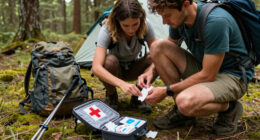
For most campers, the Sawyer Squeeze Water Filtration System with Cnoc 2-Liter Bladder is the best overall pick because its flexible setup suits both personal use and filling camp bottles. The Waterdrop Gravity Water Filter Straw is a strong choice for hands-free group water, while the Katadyn Hiker Pro fits campers who prefer a dedicated hand pump. The main tradeoffs are pack weight, how quickly you can collect water, and whether you need to filter for one person or a group. Electric models add powered convenience but bring charging and battery considerations that simple squeeze and straw filters avoid. Read on for how all 15 options compare and which setup fits your trip.

Get travel and outdoor gear delivered free with Prime
- Fast, free delivery on millions of items
- Prime Video, Amazon Music and more included
- Member-only deals all year
Complete the kit


Key Takeaways
- The Sawyer Squeeze with Cnoc bladder ranks first for versatility: it combines a familiar squeeze-filter approach with a larger reservoir, giving it more camp utility than a basic personal straw.
- Gravity filters make the most sense when several people need water: the Waterdrop 1.5-gallon options reduce hands-on effort, though their bag-based setup is bulkier than a personal filter.
- Simple filters keep the power plan easy: Sawyer, LifeStraw, and Membrane Solutions models avoid charging needs, while electric picks add convenience at the cost of power management.
- Pack count changes the use case, not just the quantity: Practical Survival’s 2-pack suits a small group or backup plan; its 5-pack favors distributing compact filters across a larger kit.
- Electric features vary across the lineup: solar charging appears on ITEHIL and Swonder models, while the Thmomex adds hand-crank charging; these options suit buyers prioritizing powered operation over minimal simplicity.
| Sawyer Products MINI Water Filtration System, Blue | 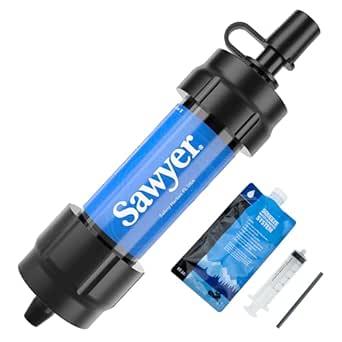 | Best Compact Pick | Filter type: 0.1-micron absolute hollow-fiber membrane | Weight: 2 oz (41 g) | Filter capacity: Up to 100,000 gallons | VIEW LATEST PRICE | See Our Full Breakdown |
| Sawyer Products SP129 Squeeze Water Filtration System with Two 32-Ounce Pouches |  | Best Value for Flexible Camp Setups | Filter pore size: 0.1 micron absolute | Filter weight: 2 ounces | Filter lifespan: Up to 100,000 gallons | VIEW LATEST PRICE | See Our Full Breakdown |
| Sawyer Squeeze Water Filtration System with Cnoc 2-Liter Bladder |  | Best for Larger Water Loads | Purification method: 0.1-micron hollow-fiber membrane | Bladder capacity: 2 liters (64 ounces) | Bladder material: TPU | VIEW LATEST PRICE | See Our Full Breakdown |
| Waterdrop Gravity Water Filter Straw with 1.5-Gallon Water Bag | 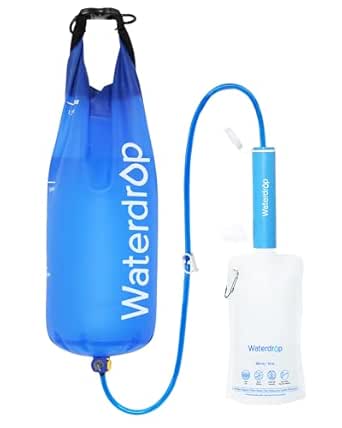 | Best Hands-Free Camp Filtering | Model: WD-FSBUL | Filtration method: Hollow-fiber ultrafiltration membrane | Pore size: 0.1 microns | VIEW LATEST PRICE | See Our Full Breakdown |
| ITEHIL Portable Electric Water Filter with Solar Charging | 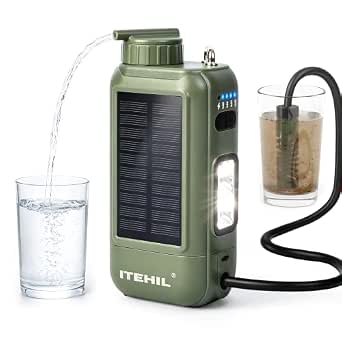 | Best Powered Feature Set | Filtration precision: 0.01 microns | Purification method: Ahlstrom filter and hollow-fiber membrane | Battery capacity: 5,200 mAh | VIEW LATEST PRICE | See Our Full Breakdown |
| LifeStraw Personal Water Filter for Hiking, Travel, and Emergencies |  | Best for Lightweight Solo Hiking | Weight: 45 g | Dimensions: 3.75 x 1.39 x 12 inches | Filtration capacity: Up to 4,000 liters (1,000 gallons) | VIEW LATEST PRICE | See Our Full Breakdown |
| BKLES BK-2000 Portable Electric Water Filter |  | Best Powered Option for Base Camp | Filtration system: Six-stage; two ultrafiltration membranes, PP cotton, KDF, and activated carbon | Pore size: 0.01 micron | Maximum flow rate: 0.67 liters per minute | VIEW LATEST PRICE | See Our Full Breakdown |
| Practical Survival Reusable Emergency Water Filter Straws, 5-Pack |  | Best Multi-Filter Emergency Stash | Quantity: 5 filters | Filtration method: Hollow fiber membrane | Bacteria and parasite reduction: Over 99.99% | VIEW LATEST PRICE | See Our Full Breakdown |
| Membrane Solutions S1 Personal Water Filter Straw |  | Best Bottle-Compatible Personal Filter | Filtration stages: 5 | Pore size: 0.1 micron | Maximum flow rate: 500 ml/min | VIEW LATEST PRICE | See Our Full Breakdown |
| Waterdrop Gravity Water Filter Straw with 1.5-Gallon Bag, 2-Pack |  | Best for Shared Camp Water | Filtration method: Hollow-fiber ultrafiltration membrane | Maximum flow rate: 700 ml/min | Filter lifespan: Up to 1,400 gallons (5,300 liters) | VIEW LATEST PRICE | See Our Full Breakdown |
| Katadyn Hiker Pro Transparent Hand Pump Water Filter |  | Best Hand-Pump Pick | Weight: 11.2 ounces | Maximum flow rate: 1 liter per minute | Filter capacity: Up to 1,150 liters | VIEW LATEST PRICE | See Our Full Breakdown |
| BKLES BK2000 Portable Electric Water Filter for Camping and Emergencies |  | Best Six-Stage Electric Pick | Model: BK2000 (BK-2000) | Filtration: Six-stage, 0.01-micron system with ultrafiltration, PP cotton, KDF, and activated carbon | Maximum flow rate: 0.74 liters per minute | VIEW LATEST PRICE | See Our Full Breakdown |
| Swonder Portable Electric Water Filter with Solar Charging |  | Best Solar-Charging Compact Pick | Filtration precision: 0.01 microns | Filtration method: Four-stage ultrafiltration | Maximum flow rate: 700 ml per minute | VIEW LATEST PRICE | See Our Full Breakdown |
| Practical Survival Reusable Emergency Water Filter Straws, 2-Pack |  | Best No-Power Backup | Quantity: 2 filters | Filtration method: Hollow fiber membrane | Bacteria and parasite removal: Over 99.99% | VIEW LATEST PRICE | See Our Full Breakdown |
| Thmomex 3-in-1 Portable Electric Water Filter with Solar and Hand-Crank Charging |  | Best Multi-Power Electric Pick | Model: K8120 | Power sources: Solar, USB-C, hand-crank | Filtration: Eight-stage system with PP cotton, activated carbon, and ultrafiltration | VIEW LATEST PRICE | See Our Full Breakdown |
| portable camping water filter | Weight | Dimensions | Maximum flow rate |
|---|---|---|---|
| Sawyer Products MINI Water Fil | 2 oz (41 g) | — | — |
| Sawyer Products SP129 Squeeze | — | — | — |
| Sawyer Squeeze Water Filtratio | Less than 6 ounces | 5.5 × 2 × 11.75 inches | — |
| Waterdrop Gravity Water Filter | — | — | 700 ml/min |
| ITEHIL Portable Electric Water | — | — | 0.18 gpm (700 ml/min) |
| LifeStraw Personal Water Filte | 45 g | 3.75 x 1.39 x 12 inches | — |
| BKLES BK-2000 Portable Electri | 350 g (12.32 ounces) | 4.72 x 3.54 x 6.69 inches | 0.67 liters per minute |
| Practical Survival Reusable Em | — | 8 x 1.5 x 1.5 inches | — |
| Membrane Solutions S1 Personal | 2 ounces | 8.1 x 2.2 x 1.6 inches | 500 ml/min |
| Waterdrop Gravity Water Filter | — | — | 700 ml/min |
| Katadyn Hiker Pro Transparent | 11.2 ounces | 3 x 3 x 6 inches | 1 liter per minute |
| BKLES BK2000 Portable Electric | 350 g (12 oz.) | — | 0.74 liters per minute |
| Swonder Portable Electric Wate | — | 3 × 2.3 × 7 inches | 700 ml per minute |
| Practical Survival Reusable Em | 56.7 g | 8 x 1.5 x 1.5 inches | — |
| Thmomex 3-in-1 Portable Electr | 360 g | 3.54 x 2.36 x 5.12 inches | 800 ml per minute |
More Details on Our Top Picks
Sawyer Products MINI Water Filtration System, Blue
At 2 ounces, the Sawyer MINI is the easiest option here to justify packing when every bit of space matters. Its 0.1-micron hollow-fiber filter connects to the included pouch, compatible 28 mm bottles, hydration-pack tubing, or the included straw, giving it more setup flexibility than a simple drink-through straw. Compared with the Sawyer SP129 Squeeze, it offers the same stated filter capacity in a smaller personal setup, while the SP129 includes two larger pouches for carrying more water at once. The MINI’s 100,000-gallon rated capacity is a strong point for repeated trips, but it still relies on manual squeezing or drawing water through the straw, and hydration-pack tubing is not included. Choose it for compact carry, not for effortless group water supply.
Pros:- Weighs 2 ounces for a low-bulk pack setup
- Connects to an included pouch, compatible 28 mm bottles, hydration tubing, or the straw
- Filters bacteria, protozoa, and microplastics according to the supplied product data
- Rated for up to 100,000 gallons
Cons:- Requires manual operation rather than powered or hands-free filtration
- Hydration-pack tubing is sold separately
- The included pouch holds only 16 ounces, less than the SP129’s two 32-ounce pouches
Best for: Solo hikers and backpackers who want a very light filter with several ways to connect it to their drinking setup.
Not ideal for: Campers who need to filter larger batches with little hands-on effort or want hydration-pack tubing included.
- Filter type:0.1-micron absolute hollow-fiber membrane
- Weight:2 oz (41 g)
- Filter capacity:Up to 100,000 gallons
- Bacteria removal:99.99999%
- Protozoa removal:99.9999%
- Compatible connections:Included pouch, standard 28 mm bottles, hydration-pack tubing, or included straw
- Included accessories:16-ounce reusable squeeze pouch, 7-inch drinking straw, cleaning plunger
- Maximum temperature:100 °F
Our verdict“Choose the Sawyer MINI if compact, adaptable personal filtration matters more than carrying a larger ready-to-filter water supply.”
Sawyer Products SP129 Squeeze Water Filtration System with Two 32-Ounce Pouches
The SP129 makes the most sense for campers who want a light filter but need more water-carrying capacity than the Sawyer MINI’s 16-ounce pouch provides. It includes two 32-ounce collapsible pouches, plus a straw and hydration-pack adapters, so it can serve as a squeeze system, bottle filter, or part of a gravity setup. Its 2-ounce filter shares the MINI’s stated 0.1-micron filtration and 100,000-gallon capacity; the difference is the more complete water-carrying kit, not a different filter rating. Compared with the Sawyer Squeeze with Cnoc 2-liter bladder, this package has smaller containers but gives you two separate pouches. The tradeoff is hands-on effort: squeezing takes work, and flow may need backwashing. It suits flexible small-group use better than quick, unattended batch filtering.
Pros:- Includes two reusable 32-ounce pouches
- 2-ounce filter connects to compatible bottles, hydration setups, and gravity configurations
- 0.1-micron filter is rated for up to 100,000 gallons
- Backwashing can restore flow to up to 98% of its original rate
Cons:- Squeezing is required unless configured for gravity or hydration use
- Flow can decrease and requires backwashing to restore
- Pouch capacity is lower than the 2-liter bladder supplied with the Sawyer Squeeze and Cnoc kit
Best for: Backpackers or small camping groups who want a lightweight filter and two separate pouches for collecting and carrying water.
Not ideal for: Campers who prefer a single high-capacity reservoir or do not want to squeeze water or maintain the filter with backwashing.
- Filter pore size:0.1 micron absolute
- Filter weight:2 ounces
- Filter lifespan:Up to 100,000 gallons
- Included pouches:Two reusable 32-ounce collapsible pouches
- Bottle compatibility:Most standard 28 mm threaded plastic bottles
- Included accessories:Drinking straw, hydration-pack adapters, mesh storage bag
Our verdict“Pick the SP129 if you want a lightweight filter with two usable pouches and more carrying flexibility than the MINI’s smaller pouch setup.”
Sawyer Squeeze Water Filtration System with Cnoc 2-Liter Bladder
The Cnoc bundle stands apart when a campsite needs more water in one fill: its 2-liter TPU bladder holds twice the volume of the SP129’s two 32-ounce pouches combined only slightly less? Two 32-ounce pouches total 64 ounces, the same stated capacity, but the Cnoc puts that volume in one wide-mouth bladder. That wide opening can make filling from shallow or awkward sources easier, while the backwashable 0.1-micron filter supports repeated use without replacement cartridges. Compared with the Sawyer MINI, this kit prioritizes a larger collection vessel over the MINI’s smaller, more packable format. Its stated weight is under 6 ounces, so it remains relatively light, but the precise weight is not given. It still requires squeezing or a compatible gravity arrangement, and the larger bladder takes more room than a personal pouch.
Pros:- 2-liter bladder carries a substantial single fill
- Wide mouth makes the bladder easier to fill at varied water sources
- Backwashable filter is designed for repeated use without replacement cartridges
- Bladder is BPA- and PVC-free
Cons:- Requires manual squeezing or a compatible gravity setup
- Weight is listed only as less than 6 ounces, not as a precise figure
- The larger bladder takes more pack space than the Sawyer MINI’s 16-ounce pouch
Best for: Backpackers who collect water for a shared camp setup and value a wide-mouth 2-liter bladder for filling and carrying.
Not ideal for: Minimalist solo hikers who want the smallest possible kit or anyone who needs an exact packed weight before choosing.
- Purification method:0.1-micron hollow-fiber membrane
- Bladder capacity:2 liters (64 ounces)
- Bladder material:TPU
- Filter lifespan:Up to 100,000 gallons
- Weight:Less than 6 ounces
- Dimensions:5.5 × 2 × 11.75 inches
- Power source:Manual
- Special features:Reusable, backwashable, BPA- and PVC-free bladder
Our verdict“Choose the Cnoc bundle if you want one wide-mouth 2-liter reservoir for camp water and can accept a larger, manually operated setup.”
Waterdrop Gravity Water Filter Straw with 1.5-Gallon Water Bag
For a campsite that needs water while people set up or cook, the Waterdrop’s gravity-fed 1.5-gallon bag offers a different workflow from the squeeze-driven Sawyer MINI and SP129. The stated maximum flow rate is 700 ml per minute, and the system can be backwashed when flow drops, making it better suited to batch filtering than sipping directly from a source. Its 0.1-micron hollow-fiber membrane is paired with filtration aimed at reducing chlorine, particles, sediment, and unpleasant tastes and odors. The tradeoff is a shorter stated capacity of 1,400 gallons compared with the Sawyer filters’ 100,000-gallon ratings. It is also bulkier than a personal filter and depends on hanging or positioning the bag for gravity flow. Choose it for camp water convenience, not the smallest carry kit or longest stated filter life.
Pros:- 1.5-gallon bag supports larger camp-water batches
- Gravity-fed design reduces the need for continuous squeezing
- Maximum stated flow rate is 700 ml per minute
- Backwashable filter can be cleaned when flow decreases
Cons:- Rated capacity of 1,400 gallons is much lower than the Sawyer filters’ stated 100,000 gallons
- Gravity operation requires a suitable place or arrangement to position the water bag
- The product data lists a 300 ppm maximum supported TDS level, which may limit use with some sources
Best for: Car campers and small groups who want to filter a larger batch of water without continuously squeezing a pouch.
Not ideal for: Ultralight solo hikers who prioritize minimum pack bulk or buyers who need the longest stated filter capacity in this lineup.
- Model:WD-FSBUL
- Filtration method:Hollow-fiber ultrafiltration membrane
- Pore size:0.1 microns
- Maximum flow rate:700 ml/min
- Filter capacity:1,400 gallons (5,300 liters)
- Water bag capacity:1.5 gallons
- Item weight:4.64 ounces
- Included components:Filter straw, 1.5-gallon gravity-fed water bag, 16-ounce water pouch
Our verdict“Choose the Waterdrop if hands-free batch filtering at camp matters more than compact carry or a very long stated filter life.”
ITEHIL Portable Electric Water Filter with Solar Charging
The ITEHIL is the powered outlier in this group: it pairs a 0.01-micron dual filtration system with a 5,200 mAh battery, USB-C and solar charging, plus an emergency light and power-bank function. That feature mix may appeal to campers who want one device to handle filtration and a few backup power tasks. Its stated flow rate of 700 ml per minute matches the Waterdrop’s maximum, but I would not treat the two as equivalent setups: Waterdrop filters by gravity with a large bag, while ITEHIL adds battery charging and a smaller stated 265-gallon capacity. The ITEHIL’s filter replacement interval is listed at six months, so it involves more upkeep than the backwashable Sawyer systems. Solar charging also takes time, and the listed one-ounce weight makes the device notably light on paper for a battery-powered unit.
Pros:- 0.01-micron dual filtration system
- Supports both USB-C and solar charging
- Includes an emergency light and power-bank function
- Maximum stated flow rate of 700 ml per minute
Cons:- Filter capacity is listed at 265 gallons, far below the Sawyer filters’ stated capacity
- Replacement is recommended every six months
- Solar charging requires time to replenish the battery
Best for: Campers who want powered water filtration alongside USB-C or solar charging, an emergency light, and a power-bank function.
Not ideal for: Backpackers seeking a simple, long-life manual filter or buyers who do not want to track battery charge and cartridge replacement.
- Filtration precision:0.01 microns
- Purification method:Ahlstrom filter and hollow-fiber membrane
- Battery capacity:5,200 mAh
- Charging options:USB-C and solar
- Maximum flow rate:0.18 gpm (700 ml/min)
- Filter capacity:1,000 liters (265 gallons)
- Filter replacement interval:6 months
- Maximum supported water TDS:1,000 ppm
Our verdict“Choose the ITEHIL if its powered filtration and backup-device features matter more to your camp kit than long filter life and simple manual operation.”
LifeStraw Personal Water Filter for Hiking, Travel, and Emergencies
At 45 g, the LifeStraw makes the most sense when I want a simple filter that takes almost no pack space. I can drink directly from a source or use a separate container, and its membrane is specified to reduce bacteria, parasites, and microplastics. Its stated 4,000-liter capacity is higher than the Membrane Solutions S1’s 1,320 gallons, though real lifespan depends on proper use and care. Unlike the Waterdrop gravity kit, this is a single-person, drink-through design: it does not provide an easy way to store or dispense filtered water for a group. That simplicity also means no pump, battery, or charging to manage. I’d choose it for compact day hikes and emergency kits, but not as my main camp water system for cooking or serving several people.
Pros:- Very light at 45 g for a personal filter
- Can be used directly from a water source or with a container
- Specified to reduce bacteria, parasites, and microplastics
- Stated filtration capacity of up to 4,000 liters
Cons:- Drink-through use is less convenient for filling bottles or cooking
- Does not provide a gravity bag or group-oriented water storage
- Stated capacity depends on correct use and maintenance
Best for: Solo hikers and emergency-kit builders who prioritize low weight and direct drinking from natural sources.
Not ideal for: Campers who need stored, ready-to-pour water or a convenient way to supply a group.
- Weight:45 g
- Dimensions:3.75 x 1.39 x 12 inches
- Filtration capacity:Up to 4,000 liters (1,000 gallons)
- Bacteria removal:99.999999%
- Parasite removal:99.999%
- Microplastic filtration:Down to 1 micron
- Material:Plastic; BPA-free
- Warranty:1 year
Our verdict“Choose the LifeStraw for a low-weight solo setup, but pick the Waterdrop gravity kit if you want filtered water ready for camp use.”
BKLES BK-2000 Portable Electric Water Filter
The BKLES BK-2000 trades the near-weightless simplicity of the LifeStraw for electric filtration and a higher stated flow rate. Its six-stage setup combines ultrafiltration membranes with PP cotton, KDF, and activated carbon, while USB-C charging and an emergency light add utility around camp. The manufacturer lists a maximum flow of 0.67 liters per minute and up to 168 liters per charge, but battery life and output can vary with conditions. At 350 g, it is much heavier and more complex than the non-electric Membrane Solutions S1, and it needs charging and eventual cartridge replacement. The listed capacity field says 17 liters, which does not match the stated per-charge volume; I would verify intended capacity before relying on it for a long trip. This is better suited to powered camp setups than ultralight hiking.
Pros:- Six-stage filtration system with two ultrafiltration membranes
- USB-C charging and electric backwashing
- Manufacturer-stated maximum flow rate of 0.67 liters per minute
- Emergency lighting adds a useful camp feature
Cons:- Heavier and bulkier than non-electric straw filters
- Requires charging, and battery performance depends on conditions
- Filter cartridges need replacement; listed capacity figures are inconsistent
Best for: Car campers and emergency-preparedness users who value powered filtration, USB-C charging, and a built-in light.
Not ideal for: Ultralight backpackers or campers who need a dependable, simple filter without battery or cartridge-management concerns.
- Filtration system:Six-stage; two ultrafiltration membranes, PP cotton, KDF, and activated carbon
- Pore size:0.01 micron
- Maximum flow rate:0.67 liters per minute
- Weight:350 g (12.32 ounces)
- Dimensions:4.72 x 3.54 x 6.69 inches
- Power and charging:Electric; USB Type-C
- Manufacturer-stated output per charge:Up to 168 liters
- Filter replacement guidance:After 180 days or 1,000 liters of purification
Our verdict“Pick the BKLES BK-2000 for powered camp convenience, not for a lightweight, low-maintenance backpacking kit.”
Practical Survival Reusable Emergency Water Filter Straws, 5-Pack
This five-pack is the clearest choice here for splitting filters among vehicles, packs, and emergency kits. Each straw uses a hollow fiber membrane and comes with its own backflushing plunger, so maintenance tools are not shared across the set. Its stated capacity of up to 1,800 gallons per filter exceeds the Membrane Solutions S1’s 1,320-gallon figure, though those capacities are manufacturer claims rather than a promise of identical performance in every water source. Compared with the LifeStraw, this package offers more filters and backflushing equipment, but its listed product shelf life is six years despite a filter-life claim of up to ten years. That mismatch makes it a less straightforward choice for long-term storage. I’d buy it for distributing emergency backups, not as a tidy group water system.
Pros:- Five separate filters can be distributed across kits
- Hollow fiber filtration specified to reduce bacteria and parasites
- Each filter includes a backflushing plunger
- Stated capacity of up to 1,800 gallons per filter
Cons:- Six-year product shelf life conflicts with the stated filter life of up to ten years
- Individual straws do not provide a convenient shared water reservoir
- Plastic straw format requires drinking through the filter or using another container
Best for: Families or preparedness-minded campers who want separate personal filters staged in several packs or emergency kits.
Not ideal for: Buyers seeking a single, clearly dated long-term storage solution or an easy shared water supply at camp.
- Quantity:5 filters
- Filtration method:Hollow fiber membrane
- Bacteria and parasite reduction:Over 99.99%
- Microplastic filtration:Down to 0.1 micron
- Capacity per filter:Up to 1,800 gallons
- Product shelf life:6 years
- Dimensions:8 x 1.5 x 1.5 inches
- Included components:One backflushing plunger per filter
Our verdict“Choose this five-pack to place personal filters in multiple emergency kits, but look elsewhere for simple shared camp water storage.”
Membrane Solutions S1 Personal Water Filter Straw
The S1’s strongest advantage over the LifeStraw is versatility: it works as a personal straw, with compatible 28 mm threaded bottles, or in gravity-fed setups. That flexibility lets me adapt it to a camp routine without stepping up to the Waterdrop kit’s dedicated bag and pouches. At two ounces, it remains light, and its listed 500 ml/min flow rate gives a useful reference for filling or drinking. The five-stage system includes hollow fiber ultrafiltration, activated carbon, and PP cotton, with NSF/ANSI 42, 372, and 401 certifications listed. One important limit: it does not lower total dissolved solids, so it is not a desalination option. Backflushing is also part of keeping the flow usable, adding a maintenance task the simple direct-use LifeStraw does not advertise in its supplied details.
Pros:- Lightweight at two ounces
- Fits 28 mm threaded bottles and supports pouch or gravity-fed setups
- Five-stage filtration includes hollow fiber membrane and activated carbon
- Listed certifications include NSF/ANSI 42, 372, and 401
Cons:- Does not reduce total dissolved solids
- Backflushing is needed to help maintain flow
- Bottle compatibility depends on a 28 mm threaded connection
Best for: Hikers who want one lightweight filter to use with a compatible bottle, pouch, or gravity-fed arrangement.
Not ideal for: Campers who need TDS reduction or want a filter system that avoids routine backflushing.
- Filtration stages:5
- Pore size:0.1 micron
- Maximum flow rate:500 ml/min
- Capacity:Up to 1,320 gallons
- Weight:2 ounces
- Dimensions:8.1 x 2.2 x 1.6 inches
- Bottle compatibility:28 mm threaded bottles
- Certifications:NSF/ANSI 42, 372, and 401
Our verdict“Choose the S1 if bottle and gravity compatibility matter more than avoiding backflushing or reducing dissolved solids.”
Waterdrop Gravity Water Filter Straw with 1.5-Gallon Bag, 2-Pack
For a camp where several people need water without taking turns drinking through a straw, the Waterdrop’s 1.5-gallon gravity bag is the key advantage. The set includes two filter straws and two 16-ounce pouches, giving it a more group-friendly setup than the LifeStraw or the bottle-oriented Membrane Solutions S1. Its stated maximum flow rate is 700 ml/min, and the hollow-fiber filter can be backwashed for reuse. That setup adds bulk and a maintenance step: when flow slows, backwashing is needed, and the bag must be filled and hung or positioned for gravity feeding. The limited 30-day filter warranty is also a narrower assurance than I’d want for gear intended to serve as a long-term camp system. I’d favor it for shared water at a fixed campsite, not for the smallest possible backpacking load.
Pros:- 1.5-gallon gravity-fed water bag supports batch filtration
- Includes two filter straws and two water pouches
- Stated maximum flow rate of 700 ml/min
- Backwashable filter is designed for reuse
Cons:- Bulkier than a single personal straw filter
- Flow can decrease and requires backwashing
- Filter warranty is limited to 30 days
Best for: Small camping groups who want to filter a larger batch of water for drinking and camp tasks.
Not ideal for: Solo ultralight hikers or buyers who want a longer filter warranty and no backwashing routine.
- Filtration method:Hollow-fiber ultrafiltration membrane
- Maximum flow rate:700 ml/min
- Filter lifespan:Up to 1,400 gallons (5,300 liters)
- Water bag capacity:1.5 gallons
- Power source:Non-electric
- Maximum supported TDS:500 ppm
- Included components:Two filter straws, one gravity-fed water bag, and two water pouches
- Warranty:30-day limited filter warranty
Our verdict“Choose the Waterdrop kit when shared, ready-to-use camp water matters more than a minimal pack size.”
Katadyn Hiker Pro Transparent Hand Pump Water Filter
The Katadyn Hiker Pro suits campers who want a direct, manually powered way to draw and filter water without depending on a battery. Its 1-liter-per-minute flow rate is faster than the BKLES BK2000’s stated 0.74 liters per minute, which can help when filling bottles at camp. The transparent body lets you monitor the cartridge, while the included pre-filter and protector add useful support around the main filter. At 11.2 ounces, it remains reasonably portable for a pump-style setup.
The tradeoff is the pumping itself: unlike the Practical Survival Reusable Emergency Water Filter Straw, this requires effort and access to a suitable water source for the intake hose. Its cartridge is rated for up to 1,150 liters, so high-volume groups may prefer a system with a larger stated capacity. I’d choose it for controlled bottle and hydration-pack filling, not for hands-free group water storage.
Pros:- Manual operation avoids reliance on batteries or charging.
- Pumps up to 1 liter per minute.
- Transparent body helps monitor the cartridge.
- Includes a pre-filter and filter protector.
Cons:- Requires ongoing manual pumping to collect water.
- Rated filter capacity is limited to 1,150 liters.
Best for: Backpackers and campers who want a manually powered pump with a faster stated flow rate and connections for bottles or hydration packs.
Not ideal for: Campers who want hands-free gravity filtration, dislike repetitive pumping, or need a high-capacity filter for frequent group use.
- Weight:11.2 ounces
- Maximum flow rate:1 liter per minute
- Filter capacity:Up to 1,150 liters
- Filtration:0.2-micron glass fiber cartridge
- Power source:Manual
- Dimensions:3 x 3 x 6 inches
- Model number:8019857
Our verdict“Choose the Katadyn Hiker Pro if you prefer a battery-free pump for filling bottles and hydration packs and are comfortable doing the pumping.”
BKLES BK2000 Portable Electric Water Filter for Camping and Emergencies
The BKLES BK2000 is aimed at campers who would rather let a battery-powered pump move water than squeeze a pouch or work a hand pump. Its stated 0.74-liter-per-minute flow rate is below the Katadyn Hiker Pro’s 1 liter per minute, but the BKLES adds a six-stage system with ultrafiltration, PP cotton, KDF, and activated carbon. The 1.5-meter hose also gives more reach from the water source, while a storage bag and emergency light make it a self-contained outdoor kit.
This convenience comes with charging uncertainty: the product data gives water treated per charge but does not specify battery life or charging details. Its listed 170 ml capacity is also not a large reservoir, so users should expect to collect water in another container. Compared with the solar- and USB-C-capable Thmomex K8120, this model offers fewer stated power options. I’d favor it for straightforward electric extraction, not for trips where charging flexibility is a priority.
Pros:- Battery-powered pumping reduces manual effort.
- Six-stage filtration includes ultrafiltration and activated carbon.
- The 1.5-meter hose offers reach from the water source.
- Includes a storage bag and built-in emergency light.
Cons:- Battery life and charging details are not provided.
- The listed 170 ml capacity is small for collecting water directly.
- Replacement filters are required.
Best for: Campers and emergency-kit users who want a battery-powered pump, a longer intake hose, and multiple filtration stages in one portable unit.
Not ideal for: Backpackers who need a clearly specified charging plan, a large built-in reservoir, or a system that works without battery power.
- Model:BK2000 (BK-2000)
- Filtration:Six-stage, 0.01-micron system with ultrafiltration, PP cotton, KDF, and activated carbon
- Maximum flow rate:0.74 liters per minute
- Water treated per charge:Up to 168,000 ml
- Power source:Battery powered
- Weight:350 g (12 oz.)
- Hose length:1.5 m
- Capacity:170 ml
Our verdict“Pick the BKLES BK2000 if you want battery-powered water extraction and multi-stage filtration, but not if you need clearly documented charging options.”
Swonder Portable Electric Water Filter with Solar Charging
The Swonder Portable Electric Water Filter makes the most sense for campers who want a compact powered filter and a backup way to recharge it away from an outlet. Its 5,200 mAh battery and solar-charging option set it apart from the battery-powered BKLES BK2000, whose charging details are not provided. The unit filters up to 700 ml per minute and includes inlet and outlet hoses, so it can draw from a source and send filtered water onward without requiring a hand-pump motion.
Solar charging is a fallback, not a fast way to keep water moving: the supplied description says 30 minutes of solar charging produces one liter of water. That makes the Thmomex K8120, with USB-C, solar, and hand-crank charging, more flexible when power access is uncertain. Swonder’s stated filter capacity is up to 1,000 liters, and replacement guidance is every six months or when flow drops. I’d pick it for compact powered convenience, not for users relying on solar alone.
Pros:- Battery and solar charging provide two power options.
- Filters up to 700 ml per minute.
- Compact dimensions suit portable camp kits.
- Includes pre-filter cartridge and inlet and outlet hoses.
Cons:- Solar charging is slow, with 30 minutes stated to produce one liter of water.
- Filter replacement is advised every six months or when flow decreases.
- The stated filter capacity is up to 1,000 liters.
Best for: Campers who want a compact electric filter with a rechargeable battery and solar charging as a backup option.
Not ideal for: Trips relying on solar as the primary power source, or buyers who want multiple non-solar backup charging methods.
- Filtration precision:0.01 microns
- Filtration method:Four-stage ultrafiltration
- Maximum flow rate:700 ml per minute
- Filter capacity:Up to 1,000 liters
- Battery capacity:5,200 mAh
- Charging:Battery and solar
- Dimensions:3 × 2.3 × 7 inches
- Included components:Pre-filter cartridge, inlet hose, outlet hose
Our verdict“Choose Swonder for compact electric filtration with solar backup, but look to the Thmomex K8120 if you want hand-crank power as well.”
Practical Survival Reusable Emergency Water Filter Straws, 2-Pack
The Practical Survival two-pack is the simplest option here for campers who want filtration without batteries, hoses, or a pump. Each hollow-fiber straw weighs about 2 ounces and is designed for direct drinking, so it packs more easily than the electric units such as the Swonder Portable Electric Water Filter. The set includes a backflushing plunger for each filter, and the product states removal of over 99.99% of waterborne bacteria and parasites, plus microplastics down to 0.1 micron.
That compact format limits how you can use it: unlike the Katadyn Hiker Pro, it is not a pump for filling bottles or hydration packs, and it depends on being able to draw water through the straw. Capacity claims are also inconsistent in the supplied data, which lists both 1,100 gallons and up to 1,800 gallons per filter. I’d treat it as a lightweight personal or emergency backup, rather than the main water system for a group campsite.
Pros:- No battery, charging, or pumping is needed.
- Two filters provide a spare or allow separate users to carry one each.
- Product data states removal of bacteria, parasites, and microplastics down to 0.1 micron.
- Each filter includes a backflushing plunger.
Cons:- Requires a water source that can be drawn through the straw.
- Capacity data is inconsistent, listing 1,100 gallons and up to 1,800 gallons per filter.
- Direct-drinking design is less suited to filling shared containers.
Best for: Solo hikers and emergency-kit planners who need a lightweight, no-power way to drink directly from a water source.
Not ideal for: Campers who need to fill bottles or shared containers, or who want a clearly consistent filter-capacity claim.
- Quantity:2 filters
- Filtration method:Hollow fiber membrane
- Bacteria and parasite removal:Over 99.99%
- Microplastic filtration:Down to 0.1 micron
- Filter capacity:Up to 1,800 gallons per filter; supplied data also lists 1,100 gallons
- Weight:56.7 g
- Dimensions:8 x 1.5 x 1.5 inches
- Features:BPA-free; one backflushing plunger per filter
Our verdict“Choose this two-pack for lightweight, no-power personal drinking, not as a convenient way to stock water for a group.”
Thmomex 3-in-1 Portable Electric Water Filter with Solar and Hand-Crank Charging
The Thmomex K8120 stands out for campers who want powered filtration without betting on a single way to recharge. It accepts USB-C, solar, and hand-crank charging, giving it more stated backup options than the Swonder, which offers battery and solar charging. Its eight-stage system uses PP cotton, activated carbon, and ultrafiltration membranes, and the claimed flow rate reaches 800 ml per minute—higher than the 700 ml-per-minute figures for Swonder and BKLES. The included 27 oz pouch and two straws help turn the compact unit into a usable camp setup.
The pouch still holds less than a group will need, so plan to refill or bring another container. The stated 5,000-liter filter capacity exceeds the capacities listed for the Katadyn Hiker Pro and Swonder, but the filter still needs replacement after reaching its limit. At 360 g, it is heavier than a simple straw such as the Practical Survival two-pack. I’d choose it for flexible power and faster stated flow, not for the lightest possible kit.
Pros:- USB-C, solar, and hand-crank charging provide multiple power options.
- Stated maximum flow rate of 800 ml per minute is the highest among the electric models in this batch.
- Includes a 27 oz water pouch, two straws, and a built-in LED light.
- Filter core is described as washable.
Cons:- The 27 oz pouch has limited capacity for group use.
- Filter replacement is required after the stated 5,000-liter capacity.
- At 360 g, it weighs more than the Practical Survival straw filters.
Best for: Campers and emergency-preparedness users who want an electric filter with several charging methods, a high stated flow rate, and included water-collection accessories.
Not ideal for: Ultralight hikers who prioritize minimum carry weight, or groups expecting the included 27 oz pouch to serve as their main water storage.
- Model:K8120
- Power sources:Solar, USB-C, hand-crank
- Filtration:Eight-stage system with PP cotton, activated carbon, and ultrafiltration
- Filtration pore size:0.01 μm
- Maximum flow rate:800 ml per minute
- Filter capacity:5,000 liters
- Weight:360 g
- Dimensions:3.54 x 2.36 x 5.12 inches
- Included components:Electric water filter, 27 oz water pouch, filter, 2 straws, manual
Our verdict“Pick the Thmomex K8120 if power flexibility and faster stated flow matter more than minimizing weight or carrying capacity.”
How We Picked
I ranked these portable camping water filters by how well their format fits real trip needs: personal drinking, filling bottles, supplying a camp group, or providing a powered option for less hands-on filtering. I weighed portability, ease of setup, capacity, likely maintenance demands, and the practical burden of carrying bags, pumps, batteries, or charging accessories. A filter that is compact but limited to one person’s drinking needs can be a smart choice, but it ranks below a more adaptable system when versatility is the roundup’s main goal.
The order reflects usefulness across common camping situations, not a claim that one style is best for every trip. The Sawyer Squeeze with Cnoc bladder leads for its adaptable reservoir-and-filter format; gravity systems follow when shared water and low-effort collection matter. Personal straws score well for simplicity and compact packing, while pump and electric models serve narrower needs that can justify their added equipment. Similar products are separated by configuration, included quantity, and charging method, since those differences affect how a buyer will carry and use them.
Factors to Consider When Choosing Portable Camping Water Filters
Choosing a filter starts with your water routine, not the longest feature list. These options span personal straws, squeeze systems, gravity bags, hand pumps, and electric units, so the right format depends on who needs water and how you plan to collect it.
Match the Filter Format to Your Camp Routine
A straw is a direct solution for drinking at a stream, but it may be awkward if you want to fill several bottles before leaving the water source. Squeeze filters give you more control over filling containers, while gravity systems let water collect with less ongoing effort. Hand pumps can suit sources where a bag is inconvenient, though pumping adds repetitive work. Think through where your water container will sit and how you will move filtered water to cooking gear. A common mistake is buying for trail drinking alone when most water use will happen at camp. Pick the format that fits your most frequent task, not the one with the most appealing accessory.
Plan for the Number of People and Water Uses
One person who mainly needs drinking water has different needs from a group cooking, washing, and refilling bottles at camp. A personal straw can be compact, yet it does not automatically solve shared-water storage or make it convenient to prepare a larger supply. Gravity bags and multi-filter packs can help with group logistics, but their extra capacity or quantity can add bulk. Estimate how many people will depend on the filter and when they will need water; peak demand often matters more than the daily average. If everyone needs water at once, a slow one-at-a-time routine can become a camp bottleneck. If your group can refill at different times, a lighter personal setup may be enough.
Account for Carry Weight Beyond the Filter
Compare the complete system you will carry, not only the filter body. Reservoirs, hoses, pouches, pumps, charging cables, and power banks can change a seemingly compact setup into a heavier kit. Included bags are useful when they replace containers you would otherwise pack, but less useful if you already carry compatible bottles. Larger systems may earn their weight on a base-camp trip where several people share them, yet feel unnecessary on a fast solo hike. Check whether the pieces pack together neatly and whether any soft reservoir needs protection from punctures. A good fit is the lightest complete setup that covers your water routine.
Treat Charging as a Trip Constraint
Electric filters can reduce manual effort, but their usefulness depends on keeping the unit powered when you need it. Solar charging depends on sunlight and time, while a hand crank requires physical effort and may take longer than expected to replace a reliable power source. Before choosing a powered model, check what charging methods are included and whether your trip gives you a practical way to replenish power. Do not assume that a solar feature means the device will stay ready through cloudy weather or shaded campsites. Simple straw, squeeze, gravity, and pump formats avoid battery planning, though each asks for a different kind of effort. Pay for powered operation when it solves a specific problem, not just because it sounds more capable.
Read Filtration Claims Against Your Water Sources
Water filters differ in what they are designed to reduce, so the word “filter” alone does not tell you whether a model matches your source. Check the manufacturer’s stated capabilities and limitations, then compare those claims with the water conditions you expect to encounter. Clear-looking water is not proof that it is suitable to drink, and a filter should not be assumed to address every kind of contamination. Some trips may call for a separate treatment step based on local guidance and source conditions. Avoid choosing solely by flow rate or a broad purification label without checking the details. When water safety is uncertain, follow current public-health guidance for the location and use a treatment method suited to the risk.
Budget Time for Care and Replacement
Maintenance affects whether a filter remains practical over many trips. Review the maker’s cleaning, backflushing, drying, storage, and replacement instructions before buying, since a system that is easy to use can still need specific care after use. Gravity bags and hoses need space and time to drain or dry, while a powered unit may have both filter and charging components to manage. Keep a plan for protecting the filter from freezing if your trips include cold nights, and check the product instructions for safe handling. Neglecting care can shorten useful life or leave the system unready for the next outing. Choose a maintenance routine you will realistically follow, rather than assuming every compact filter is maintenance-free.
Frequently Asked Questions
Should I choose a straw, squeeze filter, or gravity filter for a solo camping trip?
Choose based on how you want to collect and carry water. A straw is a natural fit if you mostly drink directly from a source and want a simple personal option. A squeeze setup makes more sense when you want to fill bottles or control how much water you filter at a time. A gravity system can be convenient at camp, but its bag may be more gear than a solo hiker needs. For a mixed routine of trail refills and camp use, compare the full packed setup rather than focusing only on the filter.
Are solar-powered water filters a dependable choice for a multi-day trip?
They can be useful, but solar charging should be treated as one part of a power plan rather than a guaranteed source. Sun exposure, weather, campsite shade, and charging time all affect whether the unit is ready when needed. Check whether the filter supports another charging method and what equipment that requires. For remote trips, consider the consequences of a depleted battery and carry a backup approach suited to the route. A non-electric filter avoids that particular uncertainty, though it requires direct effort to operate.
Is a two-pack or five-pack of personal filters better for a group?
A multi-pack can give each person a personal filter or provide spares, but it does not automatically create a shared water station. The two-pack is easier to justify for a pair or as one main filter plus a backup. A five-pack may suit a larger group that wants individual units distributed across packs. Consider whether everyone will drink directly from sources or whether camp cooking and bottle filling call for a gravity or squeeze system instead. Group size, water routines, and the need for redundancy should guide the choice.
Do I need a separate water treatment method in addition to a camping filter?
That depends on the filter’s stated capabilities and the risks associated with the water source. No single label guarantees that a filter addresses every contaminant, so read the manufacturer’s documentation and follow local public-health advice. Some settings may call for an additional treatment step, while others may be covered by a filter designed for the specific risks present. Avoid relying on water clarity as a safety test. If conditions are unknown or change during a trip, have a backup method appropriate for those conditions.
What should I do if my water filter freezes or becomes difficult to use?
Follow the manufacturer’s guidance for cold-weather handling, storage, and inspection; a filter can be damaged by freezing even if the outside looks unchanged. Keep the unit protected from freezing when conditions call for it, and do not assume it is safe to use after a freeze. Difficulty filtering can also result from clogging, poor setup, or a maintenance issue, so check the manual before forcing water through the system. Carrying a suitable backup method can prevent a single filter problem from disrupting a trip. For any damaged or questionable unit, use a different safe water plan rather than relying on guesswork.
Conclusion
For most campers, my best overall pick is the Sawyer Squeeze with Cnoc 2-Liter Bladder, thanks to its adaptable setup for both personal refills and camp use. The best value in practical utility is the Sawyer SP129 Squeeze with two pouches for buyers who want a straightforward bottle-filling system without moving to an electric device. Beginners who want a simple personal option can start with the LifeStraw Personal Water Filter, while the Waterdrop Gravity Filter is a better match for shared camp water. For buyers seeking a more involved setup, the Katadyn Hiker Pro is the best hand-pump pick; the ITEHIL or Swonder suits those specifically seeking solar charging, and Thmomex adds a hand-crank option. Choose the filter format around your group size, water routine, and ability to maintain or power it, rather than treating every feature as an upgrade.
Halloween Picks

Spirit Halloween 54-Inch Sitting Scarecrow Animatronic

10ft Halloween Inflatable Archway – Pumpkin Skeleton Yard Décor

12.5-Foot Lighted Halloween Inflatable Archway
As an affiliate, we earn on qualifying purchases.