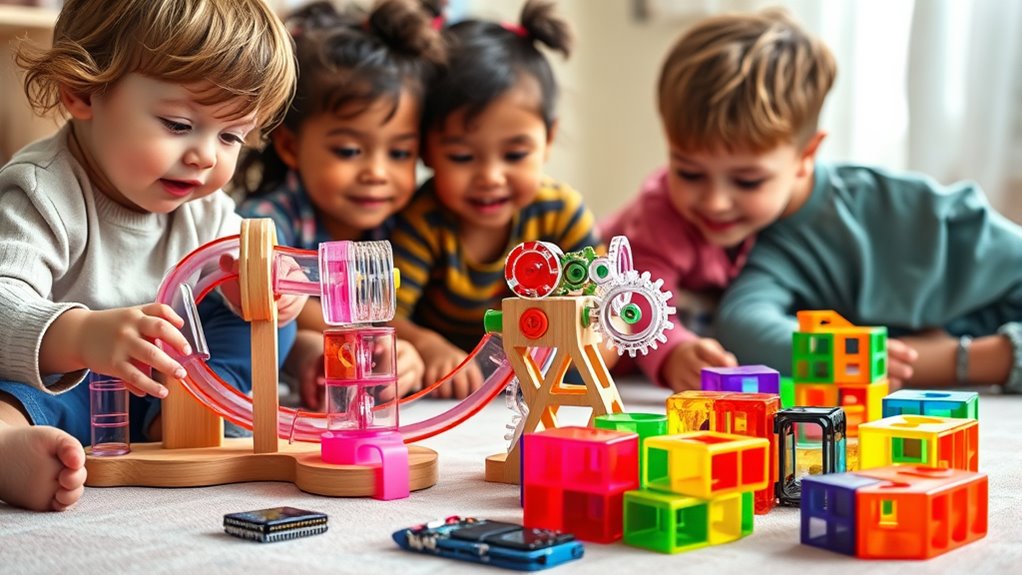

The best STEM toys for toddlers make experimenting feel like play, with activities suited to a young child’s attention span and abilities. I’d put the 2-in-1 Ball Drop & Car Ramp Race Track first for its simple cause-and-effect play, while the PicassoTiles Magnetic Tiles offer more open-ended building and the Officygnet Take Apart Dinosaurs add hands-on tool practice. The main tradeoff is between easy, repeatable play for younger toddlers and more involved sets that offer room to grow but may need adult help. Age labels, small pieces, storage, and whether a toy invites repeated play all matter as much as its STEM theme. Read on for the full breakdown and guidance on matching a toy to your child’s age and interests.

Get travel and outdoor gear delivered free with Prime
- Fast, free delivery on millions of items
- Prime Video, Amazon Music and more included
- Member-only deals all year
Complete the kit


Key Takeaways
- Simple cause-and-effect play leads the lineup: the ball-and-car ramp is the clearest fit for younger toddlers who are learning through repetition.
- Open-ended building offers more ways to play: PicassoTiles Magnetic Tiles and Hedgehog Interlocking Blocks favor construction, but their piece-based play suits children ready to handle and sort components.
- Tool toys add a different kind of problem-solving: the Officygnet dinosaur kit and TONZE tool set center on fitting, turning, and taking apart parts rather than freeform building.
- Not every science-themed toy suits the youngest toddlers: the handheld microscope is better matched to children ready to focus on looking closely and operating a screen.
- Interest can shape repeat play: the insect garden and rocket toy use familiar themes to invite exploration, while pattern blocks bring a quieter matching and shape challenge.
| Montessori Toys for 1 2 3 Year Old Boys Girls Toddlers, Wooden Toys Gifts |  | Best for Early Sorting Skills | Piece count: 20 | Material: Wood | Toy type: Stacking and sorting board | VIEW ON AMAZON | See Our Full Breakdown |
| 1000X Handheld Digital Microscope for Kids: Pocket Microscope with 2.0″ IPS Screen – STEM Toys Birthday Gifts for Girls Boys Child – Portable Edu Science Kits Toddler Age 3-6 6-12 |  | Best for Supervised Nature Discovery | Maximum magnification: 1000x | Screen: 2.0-inch IPS | Camera: 2 MP | VIEW ON AMAZON | See Our Full Breakdown |
| PicassoTiles 120pcs Hedgehog Interlocking Building Blocks Construction Toy Set for Kids Age 3+ |  | Best for Open-Ended Construction | Piece count: 120 | Block design: 3D hedgehog-shaped interlocking blocks | Age range: 3 years and up | VIEW ON AMAZON | See Our Full Breakdown |
| Officygnet 4-Pack Take Apart Dinosaur Toys with Electric Drill |  | Best for Tool-Play Enthusiasts | Age range: 3–8 years | Dinosaur count: 4 | Material: ABS plastic | VIEW ON AMAZON | See Our Full Breakdown |
| PicassoTiles 100 Piece Magnetic Tiles, Clear 3D Building Blocks for Kids 3+ |  | Best for Expanding 3D Builds | Piece count: 100 | Age guidance: 3 years and up | Material: Not specified in supplied product data | VIEW ON AMAZON | See Our Full Breakdown |
| 2-in-1 Ball Drop & Car Ramp Race Track Montessori Toy for Toddlers Ages 1-5 |  | Best for Cause-and-Effect Play | Age range: 1–5 years | Track system: 3 layers | Included play pieces: 3 light-up balls and 3 mini racing cars | VIEW ON AMAZON | See Our Full Breakdown |
| Birthday Toys Gifts for 2 3 4 5 6 Years Toddler Girls, Insect Flower Garden |  | Best for Creative Pretend Building | Age range: Ages 2–6 listed | Piece count: 156 | Flower pieces: 34 | VIEW ON AMAZON | See Our Full Breakdown |
| TONZE Wooden Kids Tool Set with Drill, Montessori Toys for 3 Year Old Boys |  | Best for Hands-On Construction | Recommended age: 3 years and up | Set contents: 44-piece wooden tool and building set | Tools: Battery drill, 2 bits, 7 hand tools | VIEW ON AMAZON | See Our Full Breakdown |
| iPlay iLearn Rocket Space Toy for Boys and Girls Ages 3-5, STEM Learning Toy |  | Best for Space-Themed STEM Play | Age range: 3–5 years | Material: Premium-quality materials; specific material not stated | Assembly: Required | VIEW ON AMAZON | See Our Full Breakdown |
| Melissa & Doug Pattern Blocks and Boards Set |  | Best for Early Shapes and Patterns | Brand: Melissa & Doug | Material: Solid wood | Pattern tiles: 120 multi-colored wooden tiles | VIEW ON AMAZON | See Our Full Breakdown |
| stem toys for toddler | Material | Age range |
|---|---|---|
| Montessori Toys for 1 2 3 Year | Wood | — |
| 1000X Handheld Digital Microsc | ABS plastic | — |
| PicassoTiles 120pcs Hedgehog I | — | 3 years and up |
| Officygnet 4-Pack Take Apart D | ABS plastic | 3–8 years |
| PicassoTiles 100 Piece Magneti | Not specified in supplied product data | — |
| 2-in-1 Ball Drop & Car Ramp Ra | Smooth plastic with rounded edges | 1–5 years |
| Birthday Toys Gifts for 2 3 4 | — | Ages 2–6 listed |
| TONZE Wooden Kids Tool Set wit | — | — |
| iPlay iLearn Rocket Space Toy | Premium-quality materials; specific material not stated | 3–5 years |
| Melissa & Doug Pattern Blocks | Solid wood | Preschool/toddler, as listed |
More Details on Our Top Picks
Montessori Toys for 1 2 3 Year Old Boys Girls Toddlers, Wooden Toys Gifts
Simple, hands-on sorting makes this wooden board the most toddler-focused choice in this group. Its 20 pieces let a child match colors and shapes, stack blocks on pegs, and notice how the holes differ, building early classification and hand-eye coordination through repeatable play. Compared with the PicassoTiles Magnetic Tiles, this set has a clearer first task and less open-ended building, which can suit a younger child who benefits from matching rather than inventing structures. The compact board and lightweight wooden pieces also make it easier to bring along than a larger construction set. The tradeoff is a narrower play arc: once a toddler masters the sorting patterns, there are fewer new challenges, and the small pieces call for age-appropriate supervision.
Pros:- Twenty pieces support sorting by color, shape, and hole pattern.
- Wooden blocks and a peg board invite direct, screen-free manipulation.
- The compact size and stated lightweight construction suit travel play.
- Several early-learning skills can be practiced with simple repeatable activities.
Cons:- The fixed board format offers less open-ended building than PicassoTiles Magnetic Tiles.
- Small individual pieces require supervision and careful storage.
- The matching tasks may offer limited challenge after a child learns the patterns.
Best for: Caregivers seeking a compact first STEM toy for a toddler practicing colors, shapes, and peg matching.
Not ideal for: Families wanting a toy that supports elaborate construction or grows into complex challenges; the fixed sorting-and-stacking format can feel limited.
- Piece count:20
- Material:Wood
- Toy type:Stacking and sorting board
- Colors:5
- Geometric shapes:5
- Dimensions:11.4 x 2.4 x 2.7 inches
- Weight:8.16 ounces
- Power:Manual; no power source
Our verdict“Choose this wooden sorter for a young toddler ready to practice basic matching and stacking, not for a child seeking open-ended construction.”
1000X Handheld Digital Microscope for Kids: Pocket Microscope with 2.0″ IPS Screen – STEM Toys Birthday Gifts for Girls Boys Child – Portable Edu Science Kits Toddler Age 3-6 6-12
Real-world observation is this microscope’s main appeal: a child can point it at specimens, adjust focus, and view them on its built-in screen rather than rely on a phone or eyepiece. Eight adjustable LEDs and photo and video storage add ways to revisit a discovery, giving it a different kind of STEM play from the PicassoTiles Hedgehog Building Blocks, which center on making structures. The handheld format is more portable than a tabletop science setup, but its manual focus and digital controls are a much bigger ask for toddlers than either building set. The listing specifies suitability for children over three, so I’d treat it as a supervised tool for an older preschooler rather than a toy for a one- or two-year-old. Battery runtime is stated at about two hours, and the advanced magnification claim does not remove the need for help positioning and focusing specimens.
Pros:- Built-in 2.0-inch screen lets children view specimens without looking through an eyepiece.
- Eight LEDs with adjustable brightness support viewing in different lighting.
- Photo and video storage can help children revisit observations.
- Portable handheld design suits supervised outings and backyard exploration.
Cons:- Manual focusing and specimen placement are less toddler-friendly than the lineup’s simple block toys.
- The listed battery runtime is about two hours, so longer outings may require recharging.
- Its digital features are unnecessary for buyers who want durable, open-ended construction play.
Best for: Adults looking for a portable, supervised nature-observation activity for a preschooler who can manage simple focus controls.
Not ideal for: Families shopping for children under three or for independent toddler play; manual focus and digital controls are likely to need adult help.
- Maximum magnification:1000x
- Screen:2.0-inch IPS
- Camera:2 MP
- Lighting:8 adjustable LEDs
- Battery capacity:600 mAh
- Stated battery runtime:About 2 hours
- Material:ABS plastic
- Weight:0.22 kg
Our verdict“Pick this for an older preschooler exploring nature with an adult, but choose a tactile building toy for younger toddlers.”
PicassoTiles 120pcs Hedgehog Interlocking Building Blocks Construction Toy Set for Kids Age 3+
Open-ended building in a manageable set gives this 120-piece kit a distinct role: children connect the hedgehog-shaped blocks into their own structures instead of following one fixed puzzle or model. That makes it more flexible than the wooden sorter, which focuses on matching shapes and colors, and less tool-dependent than the Officygnet Take Apart Dinosaur Toys. The construction process can invite experimentation, problem-solving, and shared building, while the pieces’ repeated form keeps the basic connection idea consistent. The age guidance starts at three, so this is not a fit for babies or toddlers who still mouth small objects. Its main limitation is also its signature: one block shape gives less variety in building mechanics than a mixed-piece construction kit, and the description does not specify storage or dimensions.
Pros:- A 120-piece set gives children many components for larger constructions.
- Interlocking pieces support open-ended experimentation rather than one prescribed outcome.
- Building can encourage fine-motor practice and shared problem-solving.
- The age guidance clearly identifies it for children three and up.
Cons:- The single hedgehog-shaped block design offers less component variety than mixed construction sets.
- The 3+ age guidance makes it unsuitable for younger toddlers.
- No dimensions or storage details are provided in the supplied product data.
Best for: Families with children aged three and up who enjoy inventing structures and want a shared, open-ended building activity.
Not ideal for: Caregivers seeking a toy for children under three, or children who prefer varied components and guided build instructions.
- Piece count:120
- Block design:3D hedgehog-shaped interlocking blocks
- Age range:3 years and up
- Brand:PicassoTiles
- Model:PTB120
- Set name:Hedgehog
- Manufacturer warranty:1 year
Our verdict“Choose this for a three-and-up builder who enjoys making their own structures, rather than a younger toddler who needs simpler matching play.”
Officygnet 4-Pack Take Apart Dinosaur Toys with Electric Drill
Build, take apart, and pose gives this four-dinosaur set a more structured mechanical challenge than the PicassoTiles Hedgehog blocks. Children use the included low-speed electric drill or manual screwdrivers to assemble dinosaurs, then move their joints for pretend play; the tool sequence can make cause and effect more concrete than simply connecting blocks. Four dinosaur designs also give siblings or friends options to build alongside one another. The tradeoff is that this is the most adult-dependent construction pick here: young children may need help aligning parts and handling tools, and the listed age range begins at three. Compared with the wooden Montessori sorter, it offers more involved assembly but less immediate, low-friction play. Its plastic construction and tool-based parts are better suited to supervised sessions than rough handling.
Pros:- Four dinosaurs provide more than one assembly project.
- Includes both a low-speed electric drill and manual screwdrivers for different tool experiences.
- Movable joints extend play into posing and pretend play after assembly.
- ABS construction and smooth edges are specified in the product data.
Cons:- Assembly and tool handling can require adult supervision, especially for younger children.
- More setup and part alignment are involved than with PicassoTiles Hedgehog blocks.
- The plastic parts may not suit rough handling by older children.
Best for: Families with dinosaur-loving children aged three and up who want supervised assembly and tool-use play.
Not ideal for: Caregivers seeking a simple, independent activity for a younger toddler; small hands may need help with screws, tools, and alignment.
- Age range:3–8 years
- Dinosaur count:4
- Material:ABS plastic
- Electric tool:1 low-speed electric drill
- Drill bits:2
- Manual tools:4 screwdrivers
- Included documentation:Instruction manual
- Model:Take Apart Dinosaur Toys – 817
Our verdict“Choose this for a supervised dinosaur fan who is ready to practice basic tool use, not for a toddler who needs quick, independent play.”
PicassoTiles 100 Piece Magnetic Tiles, Clear 3D Building Blocks for Kids 3+
Magnetic, three-dimensional construction makes this the broadest architecture-focused option in the group. With 100 clear tiles, children can combine shapes into larger forms and explore color, geometry, counting, and how magnetic edges connect. Unlike the PicassoTiles Hedgehog Building Blocks, which use one repeated interlocking shape, these tiles are described as supporting different geometrical forms and scalable builds; that gives a child more ways to experiment, though it may also take more planning. The set is aimed at ages three and up, not younger toddlers, and the listing describes magnetic play rather than detailed safety or durability specifications. It is also a less direct choice for a child who benefits from step-by-step matching like the wooden Montessori sorter. Easy construction and storage are claimed, but no dimensions or storage container details are supplied.
Pros:- One hundred tiles support larger structures and repeated rebuilding.
- Magnetic connections introduce a different building method from interlocking blocks.
- The product description highlights 3D forms, geometry, color, counting, and polarity.
- Designed for individual or group play and described as easy to construct and store.
Cons:- The 3+ age guidance excludes younger toddlers.
- Open-ended building may be less accessible than the wooden sorter’s clear matching tasks.
- The supplied details do not specify dimensions, tile shapes, or storage-container contents.
Best for: Families with children aged three and up who want a reusable, expandable set for exploring 3D shapes and collaborative building.
Not ideal for: Parents shopping for children under three or seeking a highly guided first STEM activity with simple matching tasks.
- Piece count:100
- Age guidance:3 years and up
- Material:Not specified in supplied product data
- Building type:Magnetic 3D tiles
- Color:Clear, colored tiles
- Power:No power source specified
- Play format:Individual or group play
Our verdict“Choose these magnetic tiles for a preschooler ready for flexible 3D building, rather than a younger toddler who needs a guided first activity.”
2-in-1 Ball Drop & Car Ramp Race Track Montessori Toy for Toddlers Ages 1-5
I’d choose this for a toddler who learns by watching an action produce an immediate result. Its three-level track lets children send either a ball or a mini car downward, while the light-up balls add a visual cue that can hold attention during repeated play. Having two play modes gives it more variety than the Melissa & Doug Pattern Blocks and Boards Set, which focuses on matching and spatial reasoning rather than moving objects. The tradeoff is that this is a more guided experience: toddlers repeat a simple drop-and-watch sequence instead of making many different structures or designs. Its plastic construction may also disappoint families seeking wooden materials, and the mini cars call for supervision with younger children. I’d rank it as a strong early-play option, not a broad construction toy.
Pros:- Ball-drop and car-ramp modes offer two ways to explore movement
- Three track levels make the route visible and easy to follow
- Light-up balls add visual interest during play
- Rounded, child-safe plastic components are described as ASTM/CPSIA compliant
Cons:- Plastic construction may not suit families prioritizing wooden or eco-conscious materials
- Mini cars require adult supervision around younger toddlers
- Play centers on repeating a fixed track activity rather than open-ended building
Best for: Families seeking an easy-to-understand first STEM toy for toddlers who enjoy ramps, motion, and repeated cause-and-effect play
Not ideal for: Caregivers who prefer wood or open-ended building, or households where small mini cars cannot be kept away from children who still mouth toys
- Age range:1–5 years
- Track system:3 layers
- Included play pieces:3 light-up balls and 3 mini racing cars
- Material:Smooth plastic with rounded edges
- Safety standards:US ASTM/CPSIA compliant
- Play features:Ball drop, car ramp, light-up balls, color recognition
Our verdict“Choose this for a young toddler drawn to simple motion and visual cause-and-effect, but pick a building set for more open-ended creation.”
Birthday Toys Gifts for 2 3 4 5 6 Years Toddler Girls, Insect Flower Garden
The Garden Building Set is my pick for toddlers who would rather arrange colorful parts into a scene than follow a fixed track or model. Its 156 pieces include flowers, stems, leaves, bases, and insects, so children can experiment with combinations while practicing hand control and pretend gardening. That makes it more open-ended than the 2-in-1 Ball Drop & Car Ramp, whose play follows a set route. The flip side is the piece count: younger children may need help sorting and connecting parts, and cleanup takes more effort than with a compact, single-activity toy. The listing describes the plastic as BPA-free, non-toxic, and odorless, but gives no specific safety certification. I’d favor it for supervised creative play, not for families who want a simple, low-piece-count introduction to STEM.
Pros:- 156 components support many flower and garden arrangements
- Flowers, stems, leaves, bases, and insects invite pretend play alongside construction
- Carrying case gives the pieces a designated storage spot
- Plastic is described as BPA-free, non-toxic, and odorless
Cons:- Large piece count can make sorting and cleanup harder for toddlers
- Small components need supervision, particularly around children who mouth toys
- Product details do not identify a specific safety certification
Best for: Caregivers of preschoolers who enjoy pretend gardening, colorful construction, and making different arrangements with adult help nearby
Not ideal for: Families seeking a low-mess, low-piece-count toy, or caregivers who want a stated ASTM/CPSIA certification before choosing a building set
- Age range:Ages 2–6 listed
- Piece count:156
- Flower pieces:34
- Stamens:24
- Stems and leaves:74
- Bases:12 green bases
- Insects:8 insects and 4 butterflies
- Material and storage:Plastic; carrying case included
Our verdict“Pick this for a supervised preschooler who likes imaginative, hands-on arranging and can manage a set with many small pieces.”
TONZE Wooden Kids Tool Set with Drill, Montessori Toys for 3 Year Old Boys
For children ready to move beyond simple stacking, I’d put the TONZE set near the top of this group for hands-on building and pretend repair. The drill, hand tools, bolts, nuts, wheels, and building pieces connect tool use with basic fastening and construction. Its guide offers 21 models, while children can also make their own designs; that gives it more directed engineering play than the Garden Building Set’s flower arranging. The wooden parts and toolbox offer a different feel from the plastic 2-in-1 Ball Drop & Car Ramp, but the battery-powered drill adds setup needs: two AA batteries are not included. The instructions also warn against overtightening, so younger builders may need an adult to loosen fasteners and guide play. I’d choose it for an engaged preschooler, not for a child who needs a fully independent, toddler-simple activity.
Pros:- Tools, bolts, nuts, wheels, and building pieces support practical construction play
- 21 model ideas provide starting points for guided builds
- Wooden parts and toolbox give the set a sturdy, organized format
- Apron and storage sections add role-play and cleanup value
Cons:- Requires 2 AA batteries, which are not included
- Children may need adult help if they overtighten bolts
- Designed for ages 3+, so it is less suited to younger toddlers
Best for: Families with a hands-on child age 3 or older who enjoys pretend repairs, guided builds, and working alongside an adult
Not ideal for: Younger toddlers or buyers seeking a battery-free toy that children can operate without help with tight fasteners
- Recommended age:3 years and up
- Set contents:44-piece wooden tool and building set
- Tools:Battery drill, 2 bits, 7 hand tools
- Building hardware:14 building pieces, 2 cubes, 4 wheels, 8 bolts, 6 nuts
- Guided builds:21 model ideas
- Materials:Wood with non-toxic water-based paint
- Included accessories:Wooden toolbox, washable polyester apron, model guide
- Battery requirement:2 AA batteries, not included
- Safety standards:Tested to ASTM F963 and CPSIA requirements
Our verdict“Choose this for a preschooler ready to explore tools and fastening with adult support, rather than for a younger toddler seeking simple independent play.”
iPlay iLearn Rocket Space Toy for Boys and Girls Ages 3-5, STEM Learning Toy
I’d shortlist this rocket for a child whose interest in space can make assembly feel like play rather than a task. The detachable stages and boosters give children parts to connect and take apart, while lights and sounds add sensory feedback. That offers a more themed, story-led experience than the TONZE Wooden Kids Tool Set, which centers on tools and model construction, but the TONZE set provides more varied building materials and guided projects. The rocket’s learning appeal depends on the child wanting to explore its assembly and space theme; the description doesn’t specify piece count, battery needs, or exactly how the parts connect. It also says assembly is required and younger children may need adult help. I’d choose it for a space enthusiast age 3–5, not as the most flexible construction set in the roundup.
Pros:- Space theme can connect assembly play with a child’s existing interests
- Detachable stages and boosters invite taking apart and reassembling
- Lights and sounds add sensory feedback
- Assembly can encourage problem-solving and hand-eye coordination
Cons:- Assembly is required, and younger children may need adult help
- Description does not specify the piece count or battery requirements
- More theme-specific and less open-ended than the TONZE tool and building set
Best for: Families with a space-loving child ages 3–5 who is interested in assembling a themed toy with adult assistance
Not ideal for: Buyers seeking detailed specifications, a clearly listed piece count, or a broad construction set with multiple model projects
- Age range:3–5 years
- Material:Premium-quality materials; specific material not stated
- Assembly:Required
- Rocket features:Boosters, detachable stages, command module
- Sensory features:Lights and sounds
- Educational focus:STEM, physics, engineering, space exploration
Our verdict“Pick this for a preschooler motivated by rockets and space, but choose a tool or block set for broader construction options.”
Melissa & Doug Pattern Blocks and Boards Set
This is the most focused choice in the group for introducing shapes, patterns, and spatial matching. Children place 120 wooden tiles on five double-sided boards, making it a quieter, more structured activity than the Garden Building Set’s pretend flower arrangements or the 2-in-1 Ball Drop & Car Ramp’s moving pieces. The boards can help a child see how shapes fit together, while open-ended tile play leaves room to make patterns beyond the printed prompts. Its strengths come with a clear limit: this is pattern-based play, not tool building, pretend engineering, or cause-and-effect exploration. The small tiles also make close supervision necessary for toddlers who still mouth toys. I’d choose it for a child ready to sort and match shapes with an adult nearby, rather than as a first toy for a very young toddler.
Pros:- 120 wooden tiles offer many ways to sort and create patterns
- Five double-sided boards provide guided matching activities
- Wood construction suits families seeking an alternative to plastic play sets
- Portable wooden box supports storage and transport
Cons:- Small tiles pose a choking risk for children who still mouth objects
- Pattern and matching play is narrower than construction-focused STEM toys
- Young toddlers may need adult guidance to use the boards
Best for: Caregivers seeking a screen-free shape and pattern activity for a preschooler who can handle small tiles with supervision
Not ideal for: Families with children who still mouth small objects, or buyers seeking moving, tool-based, or broad construction play
- Brand:Melissa & Doug
- Material:Solid wood
- Pattern tiles:120 multi-colored wooden tiles
- Puzzle boards:5 double-sided boards
- Play focus:Sorting, pattern matching, spatial awareness, early math
- Play format:Open-ended, screen-free activity
- Storage:Portable wooden box
- Age range:Preschool/toddler, as listed
Our verdict“Choose this for supervised early shape and pattern practice, not for toddlers who need larger parts or more physical construction play.”

How We Picked
I compared the ten toys by how well their activities match toddler development, not simply by how many pieces or STEM claims they offer. The main criteria were ease of grasping and operating, clarity of the play challenge, opportunities for repetition or new approaches, and the likely need for adult setup or supervision. I also weighed construction and material type, storage demands, age guidance, and whether the toy could hold interest beyond a single activity. For toddler buyers, a toy that is easy to start and rewarding to repeat can be a better fit than a more elaborate kit.
The order favors accessible, hands-on play with a clear learning action, then distinguishes toys by the child and household they suit. The ramp leads because its cause-and-effect premise is straightforward; open-ended building and tool sets follow for children ready for more choices and coordination. More specialized options, including the microscope and pattern boards, can be strong matches for particular interests but are less universal. I treat age labels as a starting point, not a substitute for checking the pieces, instructions, and supervision needs against a child’s abilities.
| stem toys for toddler | Material |
|---|---|
| Montessori Toys for 1 2 3 Year | Wood |
| 1000X Handheld Digital Microsc | ABS plastic |
| PicassoTiles 120pcs Hedgehog I | — |
| Officygnet 4-Pack Take Apart D | ABS plastic |
| PicassoTiles 100 Piece Magneti | Not specified in supplied product data |
| 2-in-1 Ball Drop & Car Ramp Ra | Smooth plastic with rounded edges |
| Birthday Toys Gifts for 2 3 4 | — |
| TONZE Wooden Kids Tool Set wit | — |
| iPlay iLearn Rocket Space Toy | Premium-quality materials; specific material not stated |
| Melissa & Doug Pattern Blocks | Solid wood |
Factors to Consider When Choosing Stem Toys For Toddlers
For toddler STEM play, the best match depends less on a toy’s label and more on what your child can do independently and what kind of play they return to. I’d check the activity, piece handling, and adult involvement before choosing a theme.
Match the challenge to the child, not just the age label
Age ranges can cover a wide span of coordination, language, and patience, so a toy marked for toddlers may still be frustrating for a particular child. Look at the actual task: dropping a ball asks for less precision than fitting a small connector or turning a screw. A useful first toy gives a child something they can try without needing an adult to complete every step. At the same time, a challenge that is too simple may lose appeal quickly. Watch how your child handles similar household objects and choose a first task just beyond what they already do comfortably. Check the manufacturer’s age guidance and warnings before buying.
Check parts, supervision, and storage before choosing a set
Piece count alone does not tell you whether a kit will work well at home. Small parts may be difficult to manage and can pose a choking risk for children who still mouth toys, so read age guidance and inspect the components carefully. Sets with many loose pieces can also take longer to set up and put away than a single-piece ramp or toy. If play will happen in short sessions, a contained activity may see more use than a large kit that needs a clear table and sorting time. Think about whether you can stay nearby while your child builds, uses tools, or explores parts. A little storage planning helps keep a versatile set from becoming a mixed-up box that is hard to restart.
Choose the kind of problem-solving your child enjoys
STEM toys can invite very different actions: observing, sorting, building, matching, or testing what happens when something moves. A child who loves cause and effect may return to ramps, while a child who likes fitting pieces may prefer construction or tool play. Matching boards offer a clearer target, which can suit children who enjoy finishing a defined task. Open-ended toys allow more possible outcomes but may require an adult to suggest a starting idea. Avoid choosing only by a toy’s science or engineering theme; the hands-on action is what shapes the play. If you are unsure, start with an activity your child already imitates during everyday play.
Decide how much adult participation fits your routine
Some toys are ready for independent exploration, while others involve assembly, instructions, or a grown-up explaining what to try. That difference can matter more than a long list of activities when playtime is brief. Adult participation can make a more involved set rewarding, but it is not a useful purchase if you expect a toddler to manage every step alone. Consider whether you want a toy for shared play or one your child can return to without much setup. For guided activities, keep instructions simple and let the child handle the pieces where safe. A toy that fits your available time is more likely to become part of regular play.
Pay for useful flexibility, not complexity by itself
A higher piece count or electronic feature does not automatically mean a toy will offer more value to a toddler. More flexibility can help a set stay interesting as skills develop, but only if the child can use its parts and the household can store them. A focused toy may provide better play when it has one clear activity that a young child can repeat in different ways. Before paying more, ask what new actions the extra components enable and whether your child is ready for them. Also consider whether the toy can be used alongside existing blocks, figures, or pretend-play props. The right choice balances room to grow with an easy first experience.
Think about cleanup and durability in everyday use
Hands-on toys get moved, dropped, and put away by small children, so practical construction matters alongside the activity. Check whether pieces are easy to wipe or sort, whether the toy has a place to store loose components, and whether the materials suit your home. A kit with many parts may offer variety but can be harder to keep complete. Toys with a simple setup can be easier to bring out often, especially for quick play sessions. Read care instructions where available, and check product details for materials and any maintenance needs. Favor a format that adults can reset without turning cleanup into a separate project.
Frequently Asked Questions
Which type of STEM toy is a good first choice for a toddler?
I’d start with a toy that has one clear action and an easy-to-see result, such as placing, dropping, or matching. That lets a child repeat the activity and discover small variations without needing to follow a long set of instructions. A complicated kit can be a better fit later, once the child enjoys handling parts and staying with a task. Check that the toy’s age guidance and components suit your child, especially if they still mouth objects. A good first choice should invite independent attempts while leaving room for a grown-up to join in.
Are building toys with lots of pieces suitable for toddlers?
They can be, but suitability depends on the child’s age, coordination, and tendency to mouth objects—not just the toy’s stated age range. Read the manufacturer’s warnings and inspect the size of individual pieces before bringing a set into a home with young children. More pieces can support sorting and construction, but they also raise the demands of setup, supervision, and cleanup. If your child is not ready to manage many components, a simpler activity may lead to more successful play. Store parts out of reach when they are not being used if younger siblings are present.
Should I choose a toy that teaches one skill or one with several activities?
For a very young toddler, one clear activity can be easier to understand and repeat, which is often how early problem-solving develops. A multi-activity toy may suit a child who enjoys switching tasks and can follow simple directions. The tradeoff is that extra activities can add parts and setup without adding much value if the child uses only one feature. Think about whether the options represent genuinely different ways to play or merely variations on the same task. If possible, choose a toy whose main activity already appeals to your child.
Do electronic or screen-based STEM toys make sense for toddlers?
They can add visual detail or make observation easier, but they are not automatically more educational than hands-on toys. Consider whether the child will actively explore, compare, or ask questions, rather than mainly watch a display. Check the recommended age, operating steps, durability, and any charging or maintenance needs before choosing one. A screen-based tool may be a stronger match for a child who can focus on looking closely than for a younger toddler who prefers moving objects around. Adult involvement can help connect what the child sees to real objects and simple questions.
How can I tell whether a toy will hold a toddler’s interest?
No toy can guarantee lasting interest, but you can look for signs that the activity offers repeatable actions or more than one way to engage. A child who likes cause and effect may revisit a ramp, while one who enjoys matching may prefer a defined pattern task. A theme that already interests the child can help draw them in, though theme alone does not make the activity engaging. Consider whether the toy can be used in short sessions and whether an adult can introduce a fresh challenge without replacing the play. Rotating toys rather than leaving every set out at once can also help keep familiar activities appealing.
Conclusion
For the broadest toddler-friendly starting point, I’d choose the 2-in-1 Ball Drop & Car Ramp Race Track as best overall for its accessible cause-and-effect play. The Montessori wooden toy set is my best-value direction for families seeking a simpler, hands-on starting point, while the PicassoTiles Magnetic Tiles are the best premium-style choice for open-ended construction and room to expand play. Beginners who want a clear activity can start with the ramp; children drawn to building may be better served by the Hedgehog blocks, while budding fixers can try the Officygnet dinosaur kit or TONZE tool set with adult guidance. For specific interests, pick the microscope for close observation, the insect garden or rocket for themed exploration, and Melissa & Doug Pattern Blocks for matching and shapes. Match the toy’s parts and demands to your child’s abilities, and the best choice is the one they can safely return to and explore.