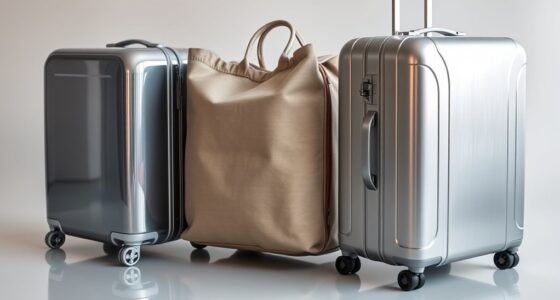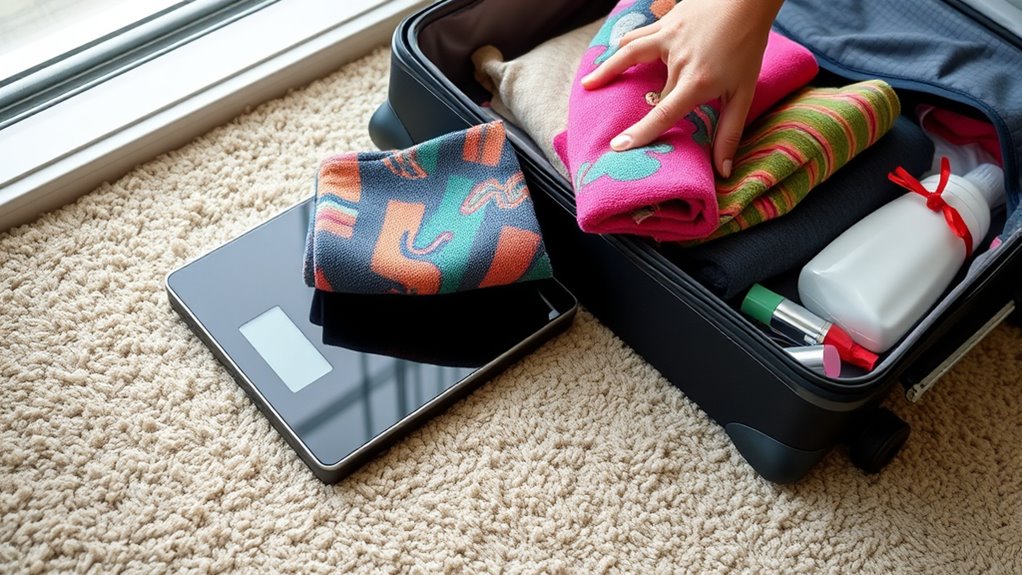

To weigh your luggage at home and avoid overweight fees, get a travel scale—digital or analog—that can handle typical airline limits. Pack your bag as usual, then lift or hang it on the scale to get an accurate weight. Weigh multiple times if needed, and adjust your packing to meet restrictions. Regularly check your scale’s accuracy to guarantee it’s reliable. Keep exploring to discover more tips for smooth travel and stress-free packing.
Key Takeaways
- Use a reliable digital or analog travel scale to weigh your luggage at home before heading to the airport.
- Pack your bag as usual, then lift or hang it onto the scale to get an accurate weight reading.
- Weigh multiple times if needed to ensure consistency, especially for heavier luggage.
- Regularly check and calibrate your scale for accuracy to avoid surprises at check-in.
- Redistribute items if your luggage approaches the airline’s weight limit to prevent overweight fees.

Traveling can be stressful enough without worrying about overweight luggage fees, but weighing your bags at home is simple and can save you money. The easiest way to do this is by using travel scales, which are compact, portable, and designed specifically for travelers. These devices allow you to perform DIY weighing of your luggage quickly and accurately, giving you peace of mind before heading to the airport. With travel scales, you can avoid the hassle of redistributing your belongings at check-in or facing unexpected charges for overweight bags.
To start, you’ll want to purchase a reliable set of travel scales. Many models are digital, providing quick readings with just the press of a button, while others are analog with a traditional dial. Choose one that suits your preferences and budget, and verify it can handle the weight limits specified by your airline, typically around 50 pounds or 23 kilograms. Once you have your travel scales, pack your luggage as you normally would, then lift or hang the bag onto the scale. Digital models usually require you to turn them on and wait for the reading, while analog scales may involve simply suspending the bag from a hook or handle.
DIY weighing with travel scales is straightforward and provides immediate results. If you’re using a digital scale, note the weight displayed on the screen. For analog scales, read the dial to determine the weight. Some travelers prefer to weigh their luggage multiple times, especially if they’re packing heavy or bulky items, to ensure accuracy. When you’re close to your airline’s limit, try redistributing some items to see if you can lighten your load without sacrificing essentials. This proactive approach prevents surprises at check-in and helps you stay within weight restrictions.
Using travel scales at home prevent you from the inconvenience and potential fees associated with overweight luggage at the airport. It’s a simple step that can make your travel experience smoother and more economical. Plus, practicing DIY weighing with your own travel scales helps you develop a better sense of your luggage’s weight over time, making packing more efficient for future trips. Remember to check your scales periodically for accuracy, especially if they are digital, to guarantee consistent readings. In the end, a quick weigh-in at home is a small effort that can lead to significant savings and less stress on travel day. Ensuring your scales are properly calibrated can also improve your accuracy and reliability.
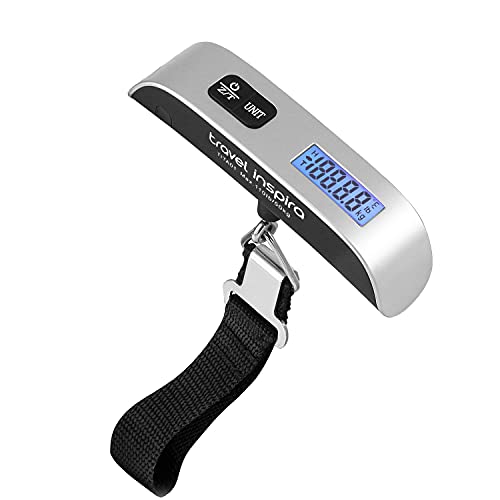
travel inspira Luggage Scale, Portable Digital Hanging Baggage Scale for Travel, Suitcase Weight Scale with Rubber Paint, 110 Pounds, Battery Included – Silver
[Travel without stress] This hanging baggage scale easily prevents overweight baggage charges; a must-have for traveling. *The isolation…
As an affiliate, we earn on qualifying purchases.
As an affiliate, we earn on qualifying purchases.
Frequently Asked Questions
Can I Use a Smartphone App to Weigh My Luggage?
Yes, you can use smartphone apps to weigh your luggage, but they’re not always perfectly accurate. These apps often rely on sensors or camera measurements, which can be a fun alternative to traditional scales. While they give you a quick estimate of your luggage weight, for precise results, it’s best to double-check with a physical scale. Remember, your phone’s tools are handy, but they might not replace a reliable luggage scale.
How Accurate Is Bathroom Scale Weighing for Luggage?
Bathroom scales can give you a rough estimate of your luggage weight, but their accuracy is limited by scale accuracy and bathroom limitations. They often aren’t designed for heavy or uneven loads, which can lead to inaccurate readings. For better precision, use a luggage scale or a more robust device. Keep in mind that bathroom scales are best suited for people, not bulky or weighted bags, so double-check if possible.
Do I Need to Weigh Each Bag Separately?
You don’t need to weigh each bag separately if you’re doing multi-bag weighing. Instead, focus on proper bag weight distribution to guarantee no single bag exceeds the limit. Use a large enough scale or a makeshift setup, like a sturdy platform or a luggage scale, to weigh all your bags together. Then, subtract the weight of your checked bag to determine individual weights, saving time and effort while avoiding overweight fees.
What if My Scale’s Battery Dies?
Imagine your scale’s display fading like a sunset—don’t panic. You just need to perform simple scale maintenance: replace the batteries with fresh ones, ensuring your device powers back to life. Keep spare batteries handy, so when your scale’s battery dies, you can quickly swap them out. Regular battery replacement keeps your scale accurate and reliable, helping you avoid overweight baggage surprises before you head to the airport.
How Can I Calibrate My Home Luggage Scale?
To calibrate your home luggage scale, start with calibration techniques like using a known weight, such as a household item or a luggage weight. Confirm proper placement by placing the scale on a flat, stable surface. Zero out the scale if it has a tare function, then weigh the known weight. Adjust the calibration screw or follow the manufacturer’s instructions to guarantee accurate readings, so you avoid surprises at the airport.
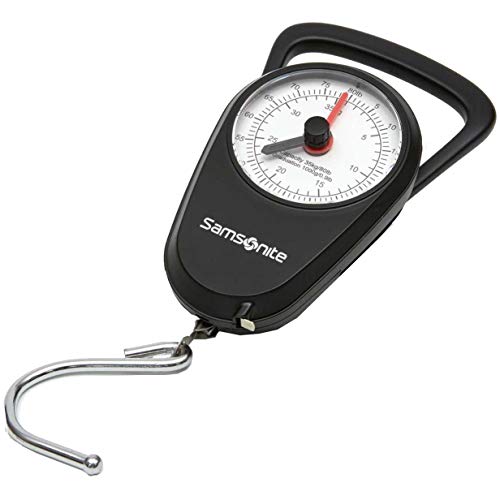
Samsonite Manual Luggage Scale, Black, One Size
Compact and portable luggage scale, registers up to 80 lbs
As an affiliate, we earn on qualifying purchases.
As an affiliate, we earn on qualifying purchases.
Conclusion
Now that you know how to weigh your luggage at home, you’re the captain of your journey. Your suitcase is no longer just baggage but a vessel carrying your stories and dreams. By keeping it within the right weight, you steer clear of hidden fees and unexpected delays. Remember, a well-balanced load guarantees smooth sailing ahead. So, weigh your luggage with care—your adventure awaits, and you hold the compass. Safe travels!
travel inspira Luggage Scale, Portable Digital Hanging Baggage Scale for Travel, Suitcase Weight Scale with Rubber Paint, 110 Pounds, Battery Included – Silver
[Travel without stress] This hanging baggage scale easily prevents overweight baggage charges; a must-have for traveling. *The isolation…
As an affiliate, we earn on qualifying purchases.
As an affiliate, we earn on qualifying purchases.
travel inspira Luggage Scale, Portable Digital Hanging Baggage Scale for Travel, Suitcase Weight Scale with Rubber Paint, 110 Pounds, Battery Included – Silver
[Travel without stress] This hanging baggage scale easily prevents overweight baggage charges; a must-have for traveling. *The isolation…
As an affiliate, we earn on qualifying purchases.
As an affiliate, we earn on qualifying purchases.